Shanghai to Beijing Train: Times, Fares, Tickets (2026)
The Shanghai to Beijing train takes about 4h 18m on the fastest G-train, from Hongqiao to Beijing South. Fares, classes, which train to pick, train vs flight.
Updated 10 min readCSK Team
On this page7 sections
Quick answer: The fastest G-train from Shanghai Hongqiao to Beijing South covers 1,318 km in about 4 hours 18 minutes. Actual second-class fares in 2026 typically sit between about ¥500 and ¥670 beneath a published ceiling of up to roughly 800 yuan. Book up to 15 days ahead on 12306 or Trip.com, and carry the physical passport used for booking.
The Beijing-Shanghai high-speed corridor is the busiest in China, running roughly 45 to 50 G-trains each way daily according to public route listings. It links two cities with very different personalities, as our Beijing vs Shanghai comparison explains. For how the rest of the network operates, see our China high-speed rail guide.
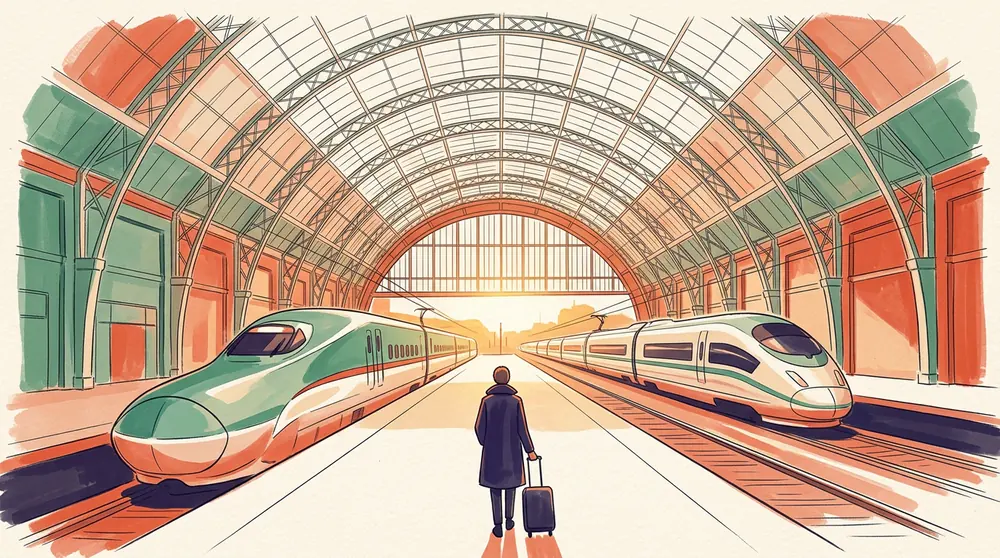
Route overview and stations
| Item | Detail |
|---|---|
| Distance | 1,318 km |
| Fastest journey | about 4h 18m (G-train) |
| Typical journey | 4h 18m to about 6h, depending on stops |
| Trains a day | roughly 45 to 50 G-trains each way (varies by source) |
| Top speed | up to 350 km/h on Fuxing trainsets |
| Main stations | Shanghai Hongqiao and Beijing South |
| Overnight option | Sleeper train, about 12 hours |
Always treat third-party timetables as a planning baseline and verify the live schedule on 12306 when your booking window opens.
| Station | City | What to know |
|---|---|---|
| Shanghai Hongqiao (上海虹桥) | Shanghai | West of the center, in the same complex as Hongqiao Airport Terminal 2. Metro lines 2, 10 and 17. Most Beijing trains and the fastest departures leave from here. |
| Shanghai Station (上海站) | Shanghai | Central, near People's Square, saving cab or metro time if you stay centrally. A small number of trains use it. |
| Beijing South (北京南) | Beijing | South of the center. Metro lines 4 and 14. The arrival point for essentially all Shanghai G-trains. |
If you are connecting from a flight at Pudong Airport to Shanghai Hongqiao, allow plenty of cross-city transfer time; our Shanghai airport to city guide breaks down the metro and bus links between the two hubs.
On arrival at Beijing South, you step directly onto the subway, which makes reaching central districts straightforward if you travel light. Read the Beijing subway guide for how those lines connect, or use DiDi at train stations if you are hauling heavy luggage and prefer a pickup zone over subway stairs.
Journey times and which train to pick
All G-trains use the same tracks, so the nearly two-hour gap between the quickest and slowest daytime services comes down to how many intermediate cities the train serves.
- Fastest G-trains, about 4h 18m. These make few or no intermediate stops and run up to 350 km/h on Fuxing trainsets. G1 is a well-known benchmark service of this type, though it runs southbound: it leaves Beijing South at 09:00 and reaches Shanghai Hongqiao at 13:18 on 2026 timetables.
- Standard G-trains, about 4.5 to 5 hours. These add a couple of intermediate stops. Because China Railway prices trains by speed and demand, slightly slower departures sometimes carry deeper discounts while costing you a little extra time on board.
- Slow G-trains, up to about 6 hours. These stop frequently down the corridor. Skip them unless peak-day tickets on faster runs are completely sold out.
- Overnight sleeper train, about 12 hours. Slower than both a flight and a daytime bullet train, an overnight sleeper folds travel time into a hotel night. It suits travelers who dislike early-morning starts and want to wake up in Beijing with a full day ahead.
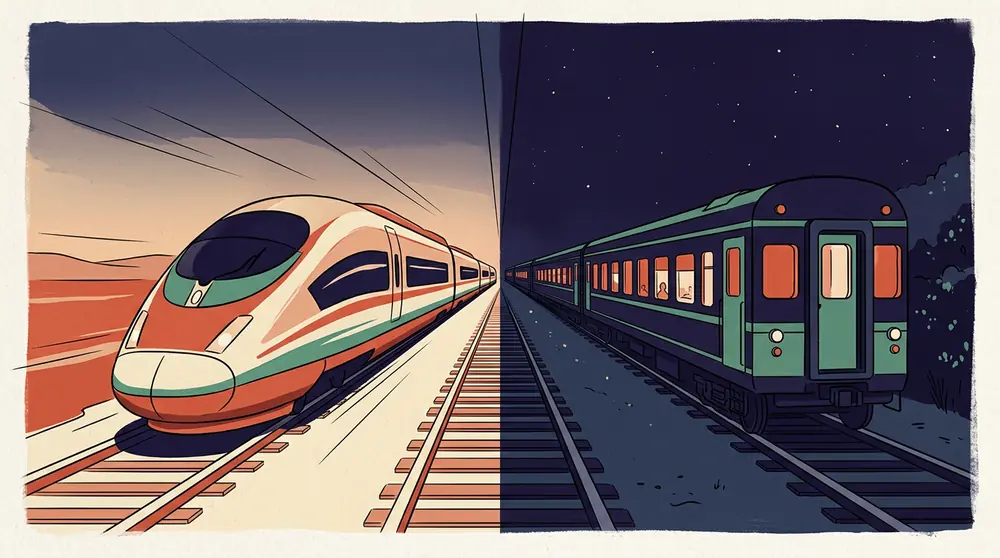
Daytime departures run from early morning into the evening, with one 2026 listing showing trains from 06:18 to 21:22. When choosing a departure, decide in this order:
- Stick to a G-train rather than a D-train unless the booking screen explicitly shows a quicker arrival for your slot.
- Filter for Shanghai Hongqiao to Beijing South and sort by total duration within your target departure window rather than grabbing the earliest train on the list, as a slightly later express can overtake a stopping train that left half an hour before it.
- Take an early-morning fast train out of Shanghai if you plan to reach the Great Wall or book timed morning sights in Beijing, putting you in the capital by lunch.
Seat classes and how 2026 floating fares work
Second class is the standard cabin where most passengers sit. First class steps up to wider seats arranged in a 2+2 layout across the aisle, while business class occupies the premium cabin at the front of the train. Under China Railway pricing formulas, first class, special class and business class are set at 1.6x, 1.8x and 3.5x the second-class base fare (The Paper, checked November 2026).
| Class | Fare listed (Mar 2026) | USD at about 6.7 |
|---|---|---|
| Second class | ¥553 (2011 launch fare; 2026 executed fares sit around ¥500 to ¥670) | about US$83 |
| First class | ¥933 | about US$139 |
| Business class | ¥1,748 (Dec 2020 floor; floats up to ¥1,998+) | about US$261 |
Third-party sites often show conflicting prices because they quote historical tariffs: ¥553 (¥555 from Shanghai Station) was the fixed second-class fare from 2011, while the December 2020 reform floated fares below a published ceiling based on train type and date, putting second class between ¥498 and ¥598 beneath a published ceiling of ¥662 from Shanghai Hongqiao and ¥669 from Shanghai Station.
On 11 May 2026, the Beijing-Shanghai high-speed rail company announced a 20% increase in published ceiling fares for 300 to 350 km/h and 200 to 250 km/h trains on the Beijing-Shanghai and Hefei-Bengbu lines, taking effect on 26 May 2026. That pushed the published second-class ceiling up to roughly 800 yuan (calculated at about ¥794 by Jiefang Daily, while Beijing News reported the 12306 screen showing a full-journey ceiling of ¥820 from 26 May, as figures differ by train and station pair).
Deeper discounts kept actual selling prices close to prior levels when the new tariff took effect: Beijing News saw the dearest full-journey second-class ticket at ¥672 versus ¥673 before, while The Paper observed a top executed fare of ¥661 and lower-demand departures starting above ¥500 (checked November 2026). For trip budgeting, treat roughly ¥500 to ¥670 (or up to ¥700 across older 2026 third-party listings) as your realistic planning range for a second-class seat. The fastest trains and peak days tend to cost more, per OLD sources. Children and certain groups qualify for discounts at the ticket window or on the booking screen. Check live prices for your exact date and train on 12306 or your booking app.
Booking tickets, changes and refunds
Tickets generally open for sale about 15 days before departure. Because business commuters and tourists pack this corridor, prime morning and afternoon express trains sell out quickly around public holidays; check the public holidays page and put a reminder in your calendar for the day your 15-day window opens. If you are connecting between regions on a transit entry, read the China 240-hour visa-free transit guide first.
- Direct on 12306. The official railway system charges no service fee. Setting it up requires an account, passport verification and an accepted payment method. Follow our 12306 English guide to get verified before tickets go on sale.
- Through Trip.com. For an English interface and billing on international bank cards, Trip.com sells the same inventory for a service fee reported at about ¥20 to ¥40 per ticket. See our guide to buying train tickets as a foreigner and how seat selection on Trip.com works.
- Without a Chinese SIM. You do not need a local mobile number to ride or book; read buying tickets without a Chinese phone number.
- At the station window. You can buy tickets in person with your passport, though popular express departures may already be full.
If your preferred departure is sold out, use 12306's free waitlist function, which automatically issues your ticket only if another passenger cancels, so do not count on one clearing.
Waitlists, changes and refunds follow the 12306 refund and change rules (Chinese) (checked November 2026). Changes made 48 hours or more before departure carry no change fee on 12306; check the app for the exact rule on your ticket. Cash refunds are free 8 or more days before departure; inside that window, the railway deducts a 5% fee between 48 hours and 8 days out, 10% between 24 and 48 hours, and 20% within 24 hours of departure.
What to expect at the station
Set up your payment and transport apps before boarding using the China pre-departure checklist, and carry the exact physical passport used when placing your order, as it serves as your ticket.
Budget 45 to 60 minutes at both Shanghai Hongqiao and Beijing South. Both terminals are built on the scale of major airports, and walking from the metro turnstiles to your departure gate takes longer than first-time visitors expect. You will pass an airport-style luggage security scanner at the station entrance, scan your passport at the ticket gate when boarding opens, and go through a second check on the platform. Boarding gates close about 5 minutes before departure, and the cut-off is strict.
Before entering security, check your daypack. Power banks must stay under 100 Wh with a clear capacity label, or you may be stopped at security; read our power bank rules for trains. If you have a gap between hotel check-out and your train, use luggage storage at stations.
High-speed train vs flight: Shanghai to Beijing
| Factor | High-speed train | Flight |
|---|---|---|
| Time on the move | About 4h 18m to 5h | Shorter in the air |
| Door to door | Center to center on metro | Add airport transfers, security and boarding |
| Delays | Trains are generally punctual | Flights are more exposed to weather and air traffic |
| Check-in | Arrive 45 to 60 minutes early | Typically 2 hours before |
| Luggage | Carry full-sized suitcases on board without checked-bag fees | Stricter liquid and baggage rules and fees apply |
| Price | Varies by train and date | Varies widely; check live prices |
Across China's rail network, a 4-to-5-hour train ride is the classic break-even point against flying, and for most travelers the train wins here once ground transfers and air-traffic-control delays along the eastern seaboard enter the math.
Flying makes sense mainly in two situations: when an airline runs a deep discount below the second-class rail fare, or when you are already at an airport connecting from an international flight. If you land at Hongqiao Airport Terminal 2 and miss a domestic flight connection, switching to a northbound G-train happens inside the same transport complex.
FAQ
How long does the train from Shanghai to Beijing take?
The fastest G-trains cover the 1,318 km route in about 4 hours 18 minutes. Most daytime high-speed trains take between 4.5 and 6 hours depending on intermediate stops, while the overnight sleeper takes about 12 hours.
How much is the Shanghai to Beijing train ticket?
Actual discounted second-class tickets typically cost about ¥500 to ¥670 (roughly US$83 to US$104 on third-party listings) beneath a May 2026 published ceiling of about ¥800. First class was listed around ¥933 in March 2026, and business class starts at ¥1,748 and floats past ¥1,998. Check live fares for your date on 12306.
Which station do I use in Shanghai and Beijing?
Most high-speed trains depart from Shanghai Hongqiao and arrive at Beijing South. A small number of services use central Shanghai Station instead, so always verify the exact station name on your booking confirmation.
Is the train better than flying from Shanghai to Beijing?
For most travelers, yes, because both main rail terminals connect directly to the metro, baggage rules are simpler, and trains are less prone to air-traffic delays. Flying makes sense mainly if you find a heavily discounted airfare or are already connecting at an airport.
Can I buy Shanghai to Beijing train tickets as a foreigner?
Yes, foreigners can book with a passport on the official 12306 app, through Trip.com for a small service fee, or in person at a station ticket window. At the station, you scan that same physical passport at the automated gate as your boarding pass.
More guides like this
- Maps & TransportHigh Speed Train Beijing to Xi'an: Times and Fares (2026)
- Maps & TransportShanghai to Zhangjiajie: Train vs Flight, Times and Fares
- Maps & Transport12306 App in English: Book China Train Tickets (2026)
- Maps & TransportHow to Buy Train Tickets in China as a Foreigner (2026)
- Maps & TransportHong Kong to Shenzhen: Train, MTR, Bus and Visa Rules
- Maps & TransportTrip.com Train Seat Selection (2026): Window vs Aisle
Rules and apps in China change often. Spotted something out of date? Tell us at [email protected]. Published November 7, 2026.