Hong Kong to Shenzhen: Train, MTR, Bus and Visa Rules
Hong Kong to Shenzhen takes about 14 minutes by high-speed rail from West Kowloon, or around an hour by MTR to Lo Wu. Compare routes, fares and visa rules.
Updated 15 min readCSK Team
On this page8 sections
Quick answer: The fastest route from Hong Kong to Shenzhen is the high-speed train from West Kowloon to Futian, taking about 14 minutes from around HK$78 (Sep 2026 listing). The MTR to Lo Wu or Lok Ma Chau costs less but involves a border walk and does not permit 240-hour visa-free transit entry. Travelers using the 240-hour transit rule must use an approved port like West Kowloon. Most foreigners need a visa or visa-free eligibility.
Hong Kong and Shenzhen touch on the map, but a full international-style boundary sits between them. Crossing it means exiting Hong Kong, clearing mainland immigration and customs, and stepping into a separate legal, internet, and payment environment. Your choice of transport is tied directly to your passport and visa status, because not every border checkpoint accepts every type of visa-free entry. Picking the wrong train can put you at a turnstile where your entry policy does not apply. If you are planning a short visit once you sort out the crossing, read our Shenzhen day trip from Hong Kong next.
Comparing the routes at a glance
Decide on your border crossing in a specific order: check your visa or visa-free eligibility first, pick a port that supports that entry rule second, and only then optimize for price or Shenzhen neighborhood.
| Route | Time | Cost | Border style | Best for |
|---|---|---|---|---|
| High-speed rail, West Kowloon to Futian | about 14 min | from about HK$78 (Sep 2026) | Immigration at West Kowloon, none at arrival | Speed, downtown Shenzhen and the route for 240-hour travelers |
| High-speed rail to Shenzhen North | about 18 to 34 min | from about HK$82 (Sep 2026) | Same | Onward mainland trains and 240-hour travelers |
| MTR East Rail to Lo Wu | roughly 45 min from Central, plus border | about HK$50 from Central in our day-trip guide; confirm MTR fare | Walk across, then Luohu | Budget, Luohu shopping (not for 240-hour entry) |
| MTR to Lok Ma Chau | similar to Lo Wu | similar | Walk across to Futian Port | Futian by metro (not for 240-hour entry) |
| Cross-border bus or coach | longer, traffic dependent | usually cheaper | Immigration at the port | Door-to-door from some areas (check the port is a 240-hour entry port) |
| Ferry to Shekou | check operator timetable | check operator | Immigration at the pier | Airport and Shekou side (Shekou is a 240-hour entry port) |
Public listings checked in 2026 (including September 2026 figures from TravelChinaGuide and MyChinaGuide) supply these fares and times, using exchange rates around 6.7 CNY per US dollar and roughly US$0.13 per HK$1. Because operators adjust schedules and pricing, confirm current fares and timetables with the carrier before travel.
High-speed rail from West Kowloon
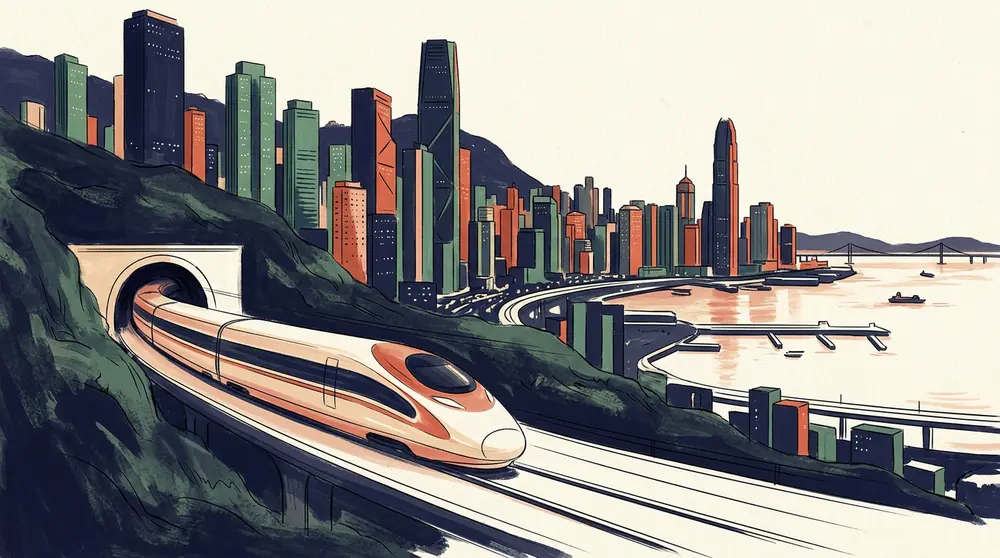
For most foreign visitors, the Guangzhou-Shenzhen-Hong Kong Express Rail Link out of Hong Kong West Kowloon Station is the cleanest way across. The station links directly via footbridges and subways to MTR Kowloon Station (on the Tung Chung Line and Airport Express) and Austin Station. TravelChinaGuide reports around 130 pairs of trains running daily between West Kowloon and Shenzhen's two main stops.
Your first choice is which Shenzhen station to book:
- Futian Station sits 26 km away in downtown Shenzhen's central business district, with a journey time of about 14 to 15 minutes. Pick this if your business or hotel is in central Shenzhen.
- Shenzhen North Station lies 39 km out and takes about 18 to 34 minutes. Choose this stop if you are connecting to onward high-speed trains deeper into mainland China.
A September 2026 MyChinaGuide listing puts second-class fares at HK$78 to Futian and HK$82 to Shenzhen North, while TravelChinaGuide reports ¥68 to ¥75 (about US$10 to US$11). Check current fares and schedules on the official MTR High Speed Rail portal at highspeed.mtr.com.hk.
How co-located immigration works at West Kowloon
West Kowloon does not work like a standard commuter station; it operates more like an airport terminal with a hard cut-off. Under its co-located border arrangement, you complete both Hong Kong exit formalities and mainland China entry immigration inside the West Kowloon building before you ever see the platform. Mainland officers decide your visa or visa-free entry inside West Kowloon, so you walk straight out into the city at Futian or Shenzhen North with no further checks.
The mistake that catches travelers out is treating the departure time like a local subway schedule. Turning up 10 minutes before your train leaves will fail. According to the MTR High Speed Rail departure process (checked November 2026), you can begin real-name ticket verification, security screening, and both immigration steps as early as 90 minutes before departure, and the entire sequence normally takes 30 to 45 minutes. Crucially, real-name check and ticket verification stop 30 minutes before the train departs. Boarding gates open 15 minutes ahead and close 5 minutes before departure. Foreign passport holders, travelers using traditional manned immigration counters, and anyone riding during summer, weekends, holidays, or on the last train of the night should expect those formalities to take longer than the 30-to-45-minute baseline.
Buying tickets, refunds, and baggage rules
Ticket sales open 15 days before departure, and you can add foreign passports as passenger IDs, according to MTR High Speed Rail guidance on buying via 12306 (checked November 2026). You can purchase through the official 12306 platform, the MTR High Speed Rail website, Trip.com, or in person at West Kowloon. See our comparison of how to buy train tickets in China to decide which platform suits you, and check China public holidays 2027 beforehand because seats can sell out around mainland holidays.
Each booking channel has practical quirks (checked November 2026):
- Searching on 12306: Typing "Shenzhen" into 12306 pulls up trains for all Shenzhen stations (including Futian and Shenzhen North) in a combined list, which makes comparing departure times easier. To find Hong Kong's station on the English 12306 interface, look under "X" or type
hkwestkowloon. - Payment and cut-offs: The English 12306 system prices tickets in RMB only and accepts International Cards as well as China UnionPay. Online sales for departures out of West Kowloon cut off 30 minutes before the train leaves.
- At the station: If you prefer to buy in person at West Kowloon, go to the manned ticketing counters, which accept HKD and RMB cash alongside electronic and mobile payments. Skip the self-service ticket machines, as MTR notes those are set up for Home Return Permit or PRC ID card holders.
If your plans shift, cross-border tickets bought on 12306 follow strict change and cancellation rules laid out in the 12306 cross-border refund rules (Chinese) (checked November 2026). You are allowed only one ticket change, and any change or refund request for a West Kowloon departure must be submitted at least 30 minutes before departure. Cancellation fees scale by how close you are to travel: 5% of the fare if cancelled 8 or more days ahead, 30% between 48 hours and 8 days ahead, and 50% within 48 hours of departure.
Families and travelers with heavy bags also face fixed limits on the High Speed Rail (checked November 2026). Child tickets are based on age: children aged 6 to under 14 pay the child fare, and those aged 14 and over pay the full fare. A child under 6 travels free if accompanied by an adult and not occupying a separate seat, and any extra child under 6 beyond one per adult needs a child ticket. Baggage is capped at 20 kg per adult and 10 kg per child, with no individual piece exceeding 130 cm in total combined dimensions, and there is no baggage consignment service at the station.
MTR East Rail Line to Lo Wu or Lok Ma Chau
Riding the MTR East Rail Line to the northern boundary is the traditional overland crossing. Instead of pre-clearing immigration in town, you ride a commuter train to the terminus, exit Hong Kong control, walk across the boundary bridge inside the terminal building, and clear mainland immigration on the Shenzhen side before stepping directly into the Shenzhen Metro system.
You choose between the two northern branches depending on where you want to end up in Shenzhen:
- Lo Wu (to Shenzhen's Luohu Port): The busiest land crossing. It drops you straight into the Luohu commercial and shopping district and connects immediately to the Shenzhen Metro.
- Lok Ma Chau (to Shenzhen's Futian Checkpoint): The alternate branch of the East Rail Line, delivering you to the southern edge of Futian and its metro connections.
The trade-off against high-speed rail comes down to money, walking, and visa rules. From Central, the MTR ride to Lo Wu takes roughly 45 minutes before you factor in the border walk, and costs about HK$50 according to our day-trip guide. However, total crossing time is unpredictable because queues fluctuate sharply by hour, day of the week, and holiday periods, and we did not find an official baseline wait time. Operating hours also vary by port and trains do not run 24 hours, so check Hong Kong Immigration Department and Shenzhen port notices on the day you travel, especially if you plan a late-night return.
Most importantly, neither Lo Wu (Luohu) nor Lok Ma Chau (Futian) can be used to enter China under the 240-hour visa-free transit policy. Under National Immigration Administration (NIA) rules for Guangdong, 240-hour transit entry is permitted at Guangzhou Baiyun, Shenzhen Bao'an, Jieyang Chaoshan, Nansha, Shekou, and, since 5 November 2025, Pazhou, Hengqin, the Hong Kong-Zhuhai-Macao Bridge, Zhongshan, and West Kowloon Station. Land checkpoints at Luohu, Futian, Huanggang, and Shenzhen Bay are excluded as entry ports for 240-hour transit, although travelers who entered legally elsewhere are allowed to exit through them.
Cross-border bus and ferry options
If you are staying far from Kowloon Station or the East Rail Line, road and sea links cover specific niches, though you should verify current routes, fares, and timetables directly with the operators before planning around them.
- Cross-border coaches: Buses pick up passengers across multiple Hong Kong districts and usually cost less than the high-speed train. They make sense when a coach stop sits right outside your hotel, saving you a transfer with luggage. The downside is road traffic and the border procedure: you must step off the bus at the land port with your belongings, walk through immigration and customs, and board again on the other side. If you rely on 240-hour transit, verify which land port the bus uses, since ports like Huanggang and Shenzhen Bay do not allow 240-hour transit entry.
- Ferries to Shekou: Ferries link Hong Kong piers with Shenzhen's Shekou port on the western side of the city. Because Shekou is an approved Guangdong entry port for the 240-hour visa-free transit rule, the ferry works well for transit travelers heading toward western Shenzhen or connecting near Shenzhen Bao'an International Airport.
What to prepare before the border check
Mainland border officers check documents systematically, and digital setup is much harder once you cross into mainland mobile networks. Sort out five items while still in Hong Kong:
-
Passport validity: Your passport must remain valid for your entire stay. If you are using the NIA 240-hour visa-free transit policy, your passport must have at least three months of remaining validity; check the exact validity threshold required for other visa or entry categories.
-
Arrival card: Since 20 November 2025, foreign visitors can submit the mainland arrival card online ahead of time through the official NIA portal at s.nia.gov.cn, the NIA 12367 app, or the official WeChat and Alipay mini programs. Filling it out is free. The NIA has issued warnings about fake lookalike websites, so stick strictly to official channels. If you prefer not to do it in advance, you can still scan a QR code at the checkpoint or fill out a paper arrival card on arrival.
-
Customs allowances: Travelers entering the mainland from Hong Kong or Macao get only half the standard duty-free tobacco allowance, and anyone crossing more than once within 15 days faces stricter customs limits. Excess goods are taxed, and you should never conceal items from customs officers.
Because mainland China regulates internet traffic and runs almost entirely on mobile payments, get your phone ready before leaving Hong Kong. Test your setup with our China firewall checker and review what changes across the boundary in our Hong Kong vs mainland comparison. Set up and link a foreign bank card to Alipay or WeChat Pay before you board your train.
Visa rules by passport and trip type
Hong Kong maintains its own immigration policy, so being visa-free in Hong Kong gives you zero automatic right to step into Shenzhen. The summary below reflects NIA policies as of 5 November 2026. Because entry rules shift, confirm your status with the NIA (en.nia.gov.cn), a Chinese embassy or consulate, or your transport carrier before departure, and run your details through our visa checker.
| Your situation | Can you enter Shenzhen? |
|---|---|
| Passport from a country on the 30-day visa-free list | Yes, for up to 30 days. 50 countries are covered, 48 of them through 31 Dec 2026. The US is not on the list. UK and Canada joined 17 Feb 2026. No extension into 2027 has been announced. See the 30-day list and China visa-free 2027. |
| Passport from a 240-hour transit country (57 countries, includes the US) | Only if you have a confirmed onward ticket to a third country or region within 240 hours and enter at a listed port. West Kowloon is a listed port; Lo Wu and Lok Ma Chau are not. |
| Foreigner on a Hong Kong or Macao agency tour group | Possible under the group policy, see below. |
| None of these | Apply for a Chinese visa before you go. |
How the 240-hour transit rule applies to Hong Kong
For travelers from the 57 eligible countries whose passports are not on the unilateral 30-day list (most notably United States citizens), the 240-hour visa-free transit rule is the main way to visit Shenzhen without a pre-arranged visa. NIA rules require an ordinary passport valid for at least three months and confirmed tickets with fixed dates and seats to a third country or region within 240 hours. The 240-hour clock starts running at 00:00 on the day after you enter.
The critical trap is the "third country or region" requirement. In mainland immigration law, Hong Kong and Macao count as separate regions. However, a simple Hong Kong – Shenzhen – Hong Kong round trip does not qualify, because your origin and your onward destination are both Hong Kong. Hong Kong only works as your onward destination if you entered the mainland from somewhere else, or if you enter from Hong Kong and hold a confirmed ticket departing the mainland (or departing via another third region such as Macao or an international flight out of Shenzhen) to a third destination. Because no official statement validates a Hong Kong-to-Shenzhen-to-Hong Kong return under this rule, confirm any complex routing with a Chinese embassy before relying on it, and read our 240-hour transit guide for full port and routing rules.
The 144-hour Guangdong tour group option
Both the NIA and the Shenzhen Port Office outline a separate regional exemption that covers 6 days (144 hours) in Guangdong. Citizens holding ordinary passports from any country that has diplomatic relations with China can enter ten Guangdong cities (Shenzhen, Guangzhou, Zhuhai, Dongguan, Foshan, Huizhou, Jiangmen, Shantou, Zhaoqing, and Zhongshan) without a visa, provided they enter from Hong Kong or Macao as part of an organized tour group booked through a travel agency registered in either SAR. The group only requires 2 or more travelers, who must enter and exit together through designated ports in those ten cities.
This policy is strictly for agency-booked groups, not solo independent travelers showing up at the border. Older guides sometimes refer to a five-day Shenzhen port visa on arrival at the border, but its current availability is not confirmed, so do not build a trip around it.
How to choose the right crossing
Match your route to your constraints:
- Traveling on 240-hour visa-free transit: Book the high-speed train from West Kowloon (or the ferry to Shekou) and carry your confirmed onward ticket to a third country or region. Skip the MTR to Lo Wu or Lok Ma Chau, which are not 240-hour entry ports.
- Short on time or carrying suitcases: Take the West Kowloon high-speed train to Futian or Shenzhen North. You clear both borders in one building, avoid long cross-bridge walks, and keep luggage within the 20 kg / 130 cm high-speed rail limit.
- Eligible for 30-day visa-free entry (or holding a visa) and watching your budget: Ride the MTR East Rail Line to Lo Wu for Luohu shopping and metro links, or to Lok Ma Chau for Futian.
- Connecting to Guangzhou or deeper into China: Take the high-speed train from West Kowloon to Shenzhen North, or book a direct train straight through to Guangzhou South; see our China high-speed rail guide for mainland network details.
FAQ
How long does it take to get from Hong Kong to Shenzhen?
The high-speed train from West Kowloon to Futian takes about 14 minutes of ride time, though MTR advises allowing 30 to 45 minutes beforehand for security and co-located immigration (where real-name checks close 30 minutes before departure). Taking the MTR East Rail Line to Lo Wu or Lok Ma Chau plus walking across the boundary usually takes an hour or more, depending on immigration queues.
Do I need a visa to go from Hong Kong to Shenzhen?
Yes, unless your passport or itinerary qualifies for a visa-free exemption. Citizens of 50 countries qualify for 30-day visa-free entry (the UK and Canada joined in February 2026, while the US is not included), and 57 countries can use the 240-hour visa-free transit rule when traveling onward to a third country or region through an approved port. Always verify current rules with the NIA before traveling.
How much is the Hong Kong to Shenzhen train?
A September 2026 listing puts second-class high-speed rail fares from West Kowloon at about HK$78 to Futian and HK$82 to Shenzhen North (roughly ¥68 to ¥75, or US$10 to US$11). Check the official MTR High Speed Rail website or 12306 for current pricing before you book.
Is the train or the MTR better for Hong Kong to Shenzhen?
The high-speed train from West Kowloon is faster, handles both border checks before boarding, and is required if you are entering by rail under the 240-hour visa-free transit policy. The MTR to Lo Wu or Lok Ma Chau is cheaper and drops you directly at Luohu or Futian port, but involves a two-stage border walk and cannot be used for 240-hour transit entry.
Can I do a Shenzhen day trip with 240-hour transit?
Not as a simple Hong Kong – Shenzhen – Hong Kong round trip, because the 240-hour rule requires a confirmed onward ticket to a third country or region, and Hong Kong only counts as an onward destination if you did not start there. To use 240-hour transit for a short visit, you must enter through an approved port like West Kowloon or Shekou (not Lo Wu or Lok Ma Chau) and exit to a third destination such as Macao or an international flight; confirm any specific routing with a Chinese embassy beforehand.
More guides like this
- Maps & Transport12306 App in English: Book China Train Tickets (2026)
- Maps & TransportHigh Speed Train Beijing to Xi'an: Times and Fares (2026)
- Maps & TransportChina Bullet Train and High Speed Rail Guide (2026)
- Maps & TransportHow to Buy Train Tickets in China as a Foreigner (2026)
- Maps & TransportShanghai to Zhangjiajie: Train vs Flight, Times and Fares
- Maps & TransportTrip.com Train Seat Selection (2026): Window vs Aisle
Rules and apps in China change often. Spotted something out of date? Tell us at [email protected]. Published November 7, 2026.