China Bullet Train and High Speed Rail Guide (2026)
China's bullet trains run on about 50,000 km of high-speed track at up to 350 km/h. Learn G, D and C trains, seat classes, stations and main routes.
Updated 14 min readCSK Team
On this page9 sections
- How big is China's high-speed rail network?
- Finding a reliable China high-speed train map
- G, D and C trains: what the letters mean
- Seat classes on high-speed trains
- How a Chinese high-speed station works
- Main high-speed rail corridors and journey times
- How fares, discounts and booking fees work
- Refunds, changes and planning tips
- FAQ
Quick answer: China's bullet train network passed 50,000 km of high-speed track at the end of 2025, the largest in the world. G-trains run at up to 350 km/h, D-trains at about 250 km/h, and C-trains are short intercity services. Most visitors book second class, arrive 45 to 60 minutes early, and scan their original passport at the station gate as their ticket.
China's high-speed railway is the most practical way to cover long distances between major cities. Knowing how the train prefixes differ, what each seat class actually buys you, and how the airport-style stations work saves time and prevents missed departures. The corridor breakdown below pairs city routes with station names and journey times so you can build a realistic itinerary. For step-by-step booking instructions, see our page on how to buy China train tickets as a foreigner.
How big is China's high-speed rail network?
China's Ministry of Transport and the national railway operator report that the country's high-speed network passed 50,000 km at the end of 2025 (Xinhua, 26 Dec 2025). The whole railway network is about 165,000 km, so high-speed lines make up roughly 30% of the total. For context, the high-speed network stood at about 38,000 km at the end of 2020.
Nearly every provincial capital and most large eastern cities are linked by fast rail, with western lines expanding steadily. For routes between major cities, start your planning with high-speed rail before looking at domestic flights.
Finding a reliable China high-speed train map
Static rail maps age poorly in a country adding thousands of kilometers of track every few years, and an outdated diagram can send you looking for the wrong terminal. Two live resources work better when planning a route:
- The Wikipedia article on high-speed rail in China maintains an updated network map and a line-by-line list that explains the "four vertical, four horizontal" backbone.
- The official booking site, 12306.cn, shows real trains, exact stations, and current timetables for any pair of cities. Searching your city pair there is more dependable than reading any static picture.
G, D and C trains: what the letters mean
Every train number starts with a letter prefix that tells you the track type and speed tier before you even look at the duration.
| Prefix | Meaning | Typical top speed | Where you meet it |
|---|---|---|---|
| G (高铁 gāotiě) | High-speed train on dedicated high-speed track | Up to 350 km/h on the fastest lines | Beijing-Shanghai, Beijing-Guangzhou, most long routes |
| D (动车 dòngchē) | EMU train, often on older or mixed track | About 200 to 250 km/h | Slower regional routes, some overnight D-trains |
| C (城际 chéngjì) | Short intercity high-speed service | Up to about 300 km/h on some lines | Beijing-Tianjin, Guangzhou-area links |
| Z, T, K | Conventional trains | 120 to 160 km/h | Overnight sleepers, budget routes |
The 350 km/h top speed belongs to the Fuxing (复兴号) trainsets operating on lines engineered for that pace; Xinhua reported the Wuhan-Guangzhou section of the Beijing-Guangzhou line moving up to 350 km/h operations in June 2024. Many other high-speed lines run at 300 km/h or slower in practice. Because top speeds vary by corridor and stopping pattern, judge a train by its scheduled total journey time rather than its letter prefix alone.
On the booking screen you will see the prefix and number combined, such as G1 or D321. When both G and D trains serve the same corridor, pick the G-train if the schedule fits: it cuts travel time significantly, and on many routes the fare gap between the two is modest. Keep D-trains in mind for regional links where G-tracks do not exist, or when an overnight D-sleeper saves a hotel night.
Seat classes on high-speed trains
Choosing a class comes down to how long you will be sitting and how much elbow room you want.
| Class | Chinese | Layout | Who it suits |
|---|---|---|---|
| Second class | 二等座 | 3+2 seats across | Most travelers; fine for trips up to 4 or 5 hours |
| First class | 一等座 | 2+2 seats, more legroom | Longer trips, travelers who want space |
| Business class | 商务座 | Wide seats, some lie-flat, front of the train | Comfort on a long day |
| Premier or special | 特等座 | Offered on some trains only | Check the booking screen |
| No seat | 无座 | Standing ticket | Only when nothing else is left |
Published fares follow set ratios, though actual ticket prices shift with discounts on individual trains. On the Beijing-Shanghai high-speed line, for example, the published ceiling fare set in December 2020 priced first class at 1.6 times second class (¥1,060 vs ¥662), special class at 1.8 times, and business class at 3.5 times second class (The Paper, checked November 2026).
For trips under four or five hours, second class is comfortable enough for most travelers and keeps costs down. First class earns its roughly 60% premium on half-day runs where removing the middle seat (moving from a 3+2 layout to 2+2) and adding legroom makes a noticeable difference. Business class makes sense mainly if you want extra comfort on a long day. Avoid "no seat" standing tickets unless an emergency forces you onto a sold-out route. Seat-letter patterns and how to sit together are covered in our Trip.com seat selection guide.
How a Chinese high-speed station works
Chinese high-speed rail stations operate more like airport terminals than European train stations. You do not stroll onto a platform two minutes before departure; you clear security, wait in the waiting hall, and pass through the ticket gate before departure.
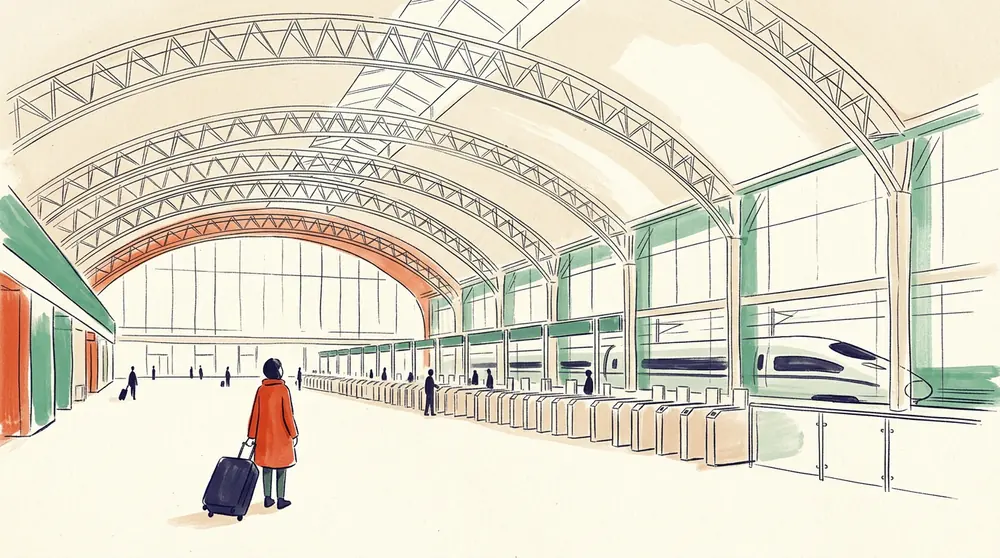
- Confirm your exact station first. Major cities have multiple terminals in different districts. Beijing South serves Shanghai trains, while Beijing West serves Xi'an trains. Check the station name on your confirmation before getting into a taxi or boarding the metro.
- Clear entrance security. Every bag goes through an X-ray scanner and you walk through a metal detector at the building entrance, often paired with an initial passport check.
- Enter the waiting hall. Follow the departure boards to your assigned gate number. Station halls are vast, and walking from security to a far gate can easily take ten minutes.
- Board through the passport gate. Gates open roughly 15 to 20 minutes before departure and close about 5 minutes before the train leaves. Late arrivals are locked out once the gate closes. Foreigners scan their original passport at the gate reader. No printed ticket is needed at most major stations, though some routes require a pickup if your booking confirmation specifies it.
- Stow luggage and settle in. Find your carriage and seat number on the ticket. Overhead racks hold standard bags, and larger suitcases fit in the racks at the ends of the car. Hot water dispensers are available in the carriages for tea or instant noodles.
Budget 45 to 60 minutes from station arrival to departure on a normal day, and add extra margin during national holidays when entrance queues lengthen. You can check the dates of upcoming peak periods on our China public holidays 2027 page. If you have hours to kill before or after a ride, see luggage storage at stations.
Why your passport and bag rules matter
China's railway enforces strict real-name ticketing. You book with a passport number, and that physical passport acts as your boarding pass. The name on the booking must match the passport exactly. If your passport is lost or replaced after you buy a ticket, go to a staffed station ticket window well before departure; do not attempt to board using a booking tied to a passport you no longer carry.
Security scanners also flag prohibited items. Power banks are permitted on trains within strict limits, primarily a 100 Wh capacity cap and legible factory markings. Review our power bank rules for trains and flights before packing so your charger is not confiscated at the X-ray belt.
Main high-speed rail corridors and journey times
The table below lists the fastest published G-train times and second-class fare ranges from public route listings reviewed between March and September 2026 (sources listed below the table; USD converted at about 6.7 CNY per dollar). Notice that on the flagship Beijing-Shanghai line, the ¥553 figure still seen in some older listings was the 2011 launch fare; the published second-class ceiling was set at ¥662 in December 2020 and raised by 20% from 26 May 2026 (The Paper, checked November 2026). Because China Railway adjusts actual fares per train and date, use these numbers for rough budgeting and check live prices on 12306 or your booking app.
| Corridor | Stations used | Distance | Fastest G-train | Second class (2026 listings) | Notes |
|---|---|---|---|---|---|
| Beijing to Shanghai | Beijing South to Shanghai Hongqiao | 1,318 km | about 4h 18m | published ceiling ¥662 (Dec 2020), raised 20% from 26 May 2026 to about ¥794; live fares are discounted (about US$99 before the rise) | Busiest route; see Shanghai to Beijing train |
| Beijing to Xi'an | Beijing West to Xi'an North | 1,216 km | about 4h 10m | about ¥515 to ¥620 (US$77 to US$93) | See Beijing to Xi'an train |
| Beijing to Guangzhou | Beijing West to Guangzhou South | 2,298 km | about 7h 17m | about ¥878 to ¥1,036 (US$131 to US$155) | Most travelers fly this one |
| Shanghai to Guangzhou | Hongqiao to Guangzhou South | about 1,790 km | about 6h 14m | from about ¥793 (US$118) | Few direct trains a day |
| Beijing to Chengdu | Beijing West to Chengdu East | about 1,800 to 2,400 km by route | about 7h 30m | about ¥748 and up (US$112) | Flights are about 3 hours |
| Xi'an to Chengdu | Xi'an North to Chengdu East | 658 km | about 3h 5m | about ¥221 to ¥335 (US$33 to US$50) | Many trains an hour |
| Shanghai to Hangzhou | Hongqiao to Hangzhou East | 160 km | about 45m | about ¥65 to ¥78 (US$10 to US$12) | Over 100 trains a day |
| Guangzhou to Shenzhen | Guangzhou South to Shenzhen North | about 150 km | about 29m | about ¥54 to ¥83 (US$8 to US$12) | Trains every few minutes |
| Hong Kong to Shenzhen | West Kowloon to Futian or Shenzhen North | 26 to 39 km | about 14 to 19m | from about HK$78 (US$10), Sep 2026 | See Hong Kong to Shenzhen |
| Hong Kong to Guangzhou | West Kowloon to Guangzhou South | 141 km | about 47m | from about HK$247 (US$32), Sep 2026 | Immigration at West Kowloon |
Sources for the table: public route listings from TravelChinaGuide (Jul 2026 schedules), China for Travelers (Jun to Jul 2026), Chinavigators (Mar 2026), Toolrid (Sep 2026) and MyChinaGuide (Sep 2026). Distances and times differ slightly between sources; where sources conflict, the table shows the range.
Train vs plane: how to choose by journey time
- Under 3 hours: take the train every time. Once you factor in airport transfers and early check-in, rail easily beats flying on corridors like Shanghai-Hangzhou, Guangzhou-Shenzhen, and Xi'an-Chengdu.
- 3 to 5 hours: the train usually wins door to door. Flagship routes like Beijing-Shanghai and Beijing-Xi'an sit in this sweet spot, delivering you from city center to city center in just over four hours.
- Over 6 hours: flying is faster on the clock. Routes like Beijing-Guangzhou (over 7 hours) or Beijing-Chengdu (about 7.5 hours vs a 3-hour flight) favor planes if time is tight, though a daytime train remains a solid alternative if you want to watch the countryside change or prefer avoiding airports.
How fares, discounts and booking fees work
High-speed rail pricing is no longer a single fixed number per route. Fares displayed on 12306 are discounted "executed" fares that sit below a published ceiling price; railway operators adjust the discount by season, weekday versus holiday, time of day, seat class, and route competition (Xinhua, checked November 2026). As 12306 explained to Xinhua, when travelers notice higher ticket prices over peak holidays, they are seeing a smaller discount off the published ceiling rather than a surcharged fare.
Even when an off-peak flight looks similarly priced to a four-hour train, rail often comes out ahead once you add the cost and time of long airport taxi rides. You can check current exchange rates with our CNY converter.
Where you book also affects what you pay and how you pay:
- Official 12306 (no fee): The official English 12306 website and app charge zero booking fees, sell tickets in RMB only, and accept International Cards or China UnionPay for foreign-passport holders (MTR High Speed Rail: buying on 12306, checked November 2026). Online ticket sales run daily from 05:00 to 01:00, opening 15 days before departure and closing 30 minutes before the train leaves. Keep two platform limits in mind: each passenger can buy only one ticket for the same train on the same day, and if your account cancels an order more than 3 times in a single day, 12306 blocks that account from buying online for the rest of the day.
- Third-party agencies (service fee): Platforms like Trip.com add a service fee reported at roughly ¥20 to ¥40 per ticket, which some travelers willingly pay for a smoother foreign-card checkout or advance reservation queuing. Compare both methods in our 12306 English guide and our guide to buying tickets without a Chinese phone number.
Refunds, changes and planning tips
Plans change on the road, and China Railway's rules reward acting before the 48-hour mark. Under the official 12306 refund and change rules (Chinese) (checked November 2026), domestic train policies work on strict time tiers (rules can change, so check the official page if your trip is tight):
- Cancellation refunds: Canceling a ticket is free if done 8 or more days before departure. Within 8 days, the fee steps up by how close you are to departure: 5% of the ticket price from 8 days down to 48 hours before departure, 10% between 48 and 24 hours, and 20% within 24 hours of departure.
- Mistaken-purchase grace window: For trips from 2 February 2026, 12306 gives each account one free "mistaken purchase" refund per day if you cancel within 30 minutes of buying and at least 4 hours before departure (this does not apply to changed, waitlisted, or group tickets).
- Changing a ticket (rebooking): You can change a ticket once. Rebooking is free if done 48 hours or more before departure for any train within the sale window. Under 48 hours, changing to a train on or before your original travel date is still free, but moving to a later date carries a fee of 5% (when done 24 to 48 hours before departure) or 15% (under 24 hours) of the lower fare. Note that if you rebook a ticket onto a train during the Spring Festival travel period and later cancel it for a refund, the later refund is charged at 20%.
To keep your transit days smooth, build these habits into your schedule:
- Set an alarm for peak dates. Because tickets go on sale 15 days ahead, popular trains around National Day and Spring Festival can vanish minutes after release.
- Use the official waitlist immediately. If your preferred train shows sold out on 12306, join the waitlist right away; it fills from cancellations.
- Plan your arrival station transfer before boarding. Major hubs like Beijing South, Shanghai Hongqiao, and Xi'an North connect directly to local subway lines, which often beat taxi queues at peak hours. Check the Beijing subway guide or the metro apps guide before you arrive, or read DiDi pickup at airports and train stations if you prefer a car.
FAQ
How fast is the bullet train in China?
G-trains on the newest lines run at up to 350 km/h, while many other high-speed lines operate at 300 km/h or slower and D-trains run at about 200 to 250 km/h. On the flagship Beijing to Shanghai route, the fastest G-trains take about 4 hours 18 minutes.
How big is China's high-speed rail network?
Official figures report that China's high-speed rail network passed 50,000 km of track at the end of 2025, making it the largest in the world and accounting for roughly 30% of the country's entire 165,000 km railway system. Check the 12306 site for current routes between specific cities.
What is the difference between G, D and C trains?
G-trains are the fastest services running on dedicated high-speed lines at up to 350 km/h, D-trains are slower EMU services running around 200 to 250 km/h, and C-trains are short intercity high-speed links. Z, T and K prefixes belong to conventional trains running at 120 to 160 km/h, used mainly for overnight sleepers or budget travel.
Can foreigners ride China's bullet trains?
Yes, foreigners book tickets using a passport on the English 12306 site or app, through third-party agencies like Trip.com, or at station ticket windows. At the station, you scan that same original passport at the gate reader to board without needing a paper ticket on most routes.
Where can I see a China high-speed train map?
Wikipedia's article on high-speed rail in China maintains an updated network map and route breakdown. For live schedules, exact stations and current fares between any two cities, search your route directly on 12306.cn.
More guides like this
- Maps & TransportHigh Speed Train Beijing to Xi'an: Times and Fares (2026)
- Maps & Transport12306 App in English: Book China Train Tickets (2026)
- Maps & TransportHow to Buy Train Tickets in China as a Foreigner (2026)
- Maps & TransportDiDi Airport & Train Station Pickup in China (2026)
- Maps & TransportTrip.com Train Seat Selection (2026): Window vs Aisle
- Maps & TransportShanghai Airport to City Center: Options 2026 (PVG & SHA)
Rules and apps in China change often. Spotted something out of date? Tell us at [email protected]. Published November 7, 2026.