Zhangjiajie National Forest Park Tickets: 2026 Guide
Zhangjiajie National Forest Park tickets cost ¥240 for 4 days (about US$36), passport needed. How a foreigner books, what costs extra, and the traps to avoid.
Updated 10 min readCSK Team
On this page7 sections
- What the ¥240 combined ticket covers (and what it leaves out)
- All Zhangjiajie ticket and lift prices in one table
- Entry rules: time slots, station locks, and re-entry bookings
- How a foreigner books the ticket
- Cable cars and the Bailong Elevator: how to choose
- How many days to budget, when to visit, and getting there
- FAQ
Quick answer: The Zhangjiajie National Forest Park combined ticket is ¥240 (about US$36) for 4 days, or ¥298 for an annual pass, including the in-park eco-buses. The Bailong Elevator and cable cars cost extra. Entry requires a passport, face recognition, and a time-slot reservation for a specific gate on every day you enter. Most travelers need only the 4-day pass.
Some links on this page are affiliate links, which means we may earn a commission at no cost to you.
Prices and entry rules below come from the official Zhangjiajie Tourism Information Web notice published 7 Sep 2026 (last checked 5 Nov 2026), the Zhangjiajie tourism web 2026 Forest Park ticket policy, and the Forest Park National Day 2026 visitor notice on Rednet (both checked November 2026). Because one other official-looking operator page lists slightly different figures (¥236 for the combined pass and ¥310 for the annual pass, citing 2025 provincial and 2026 city notices), and because lift or entry fees can shift, confirm current rates on the day you book.
What the ¥240 combined ticket covers (and what it leaves out)
From 1 Jan 2026, the park applies peak-season pricing all year. There is no discounted one-day tourist pass in the official tariff. Even for a single day, almost every visitor should buy the ¥240 combined pass, valid for four consecutive days with the in-park eco-bus shuttle network. The official policy also lists a bare entrance-only ticket at ¥168 and an unlimited annual pass at ¥298. An optional ¥3 insurance fee is not included in the base fare; uncheck or decline it at the counter if you already carry travel coverage. Unless you plan to hike every road between valleys on foot, the entrance-only option is a false economy; the scenic zones sit far apart, and the eco-buses are how you move between trailheads and upper ridge stops.
Concession tickets cost ¥160 for the combined pass with eco-bus, or ¥87 for entrance only. These discounts apply to visitors aged 14 to under 18 and seniors aged 60 to under 65 with valid ID, as well as full-time undergraduate and younger students showing a student card.
Once inside, the single pass covers all the core scenic zones within the Forest Park boundary without separate admission at individual valleys or viewpoints:
- Yuanjiajie, home of the "Avatar Hallelujah Mountain" pillar
- Tianzi Mountain
- Yangjiajie
- Golden Whip Stream
- Huangshizhai (Yellow Stone Village)
- Yaozizhai
- Ten-Mile Gallery
- Suoxiyu Valley
- The in-park eco-buses linking these zones
For help deciding how to link these zones on foot and by bus, see our Avatar mountains visitor guide and the Golden Whip Stream guide.
All Zhangjiajie ticket and lift prices in one table
| Item | Price (CNY) | About US$ | Included in park ticket? |
|---|---|---|---|
| Forest Park, 4-day pass | ¥240 | $36 | Yes, this is the ticket |
| Forest Park, annual pass | ¥298 | $44 | Yes |
| Bailong Elevator | ¥65 one way, ¥130 return | $10 / $19 | No |
| Tianzi Mountain cable car | ¥72 one way, ¥144 return | $11 / $21 | No |
| Yangjiajie cable car | ¥76 one way, ¥152 return | $11 / $23 | No |
| Huangshizhai cable car | ¥65 one way, ¥130 return | $10 / $19 | No |
| Ten-Mile Gallery sightseeing train | ¥38 one way, ¥76 return | $6 / $11 | No |
| Tianmen Mountain, one day | ¥288 | $43 | Separate ticket |
| Grand Canyon and Glass Bridge, B line | ¥50 + ¥125 + ¥3 insurance | $27 | Separate ticket |
| Yellow Dragon Cave | ¥125 | $19 | Separate ticket |
| Baofeng Lake | ¥121 | $18 | Separate ticket |
US dollar conversions are rounded at roughly ¥6.7 to the dollar. Prices for individual lifts vary slightly between sources, so treat the figures above as your baseline and expect minor adjustments.
Notice the bottom four rows: Tianmen Mountain, the Grand Canyon Glass Bridge (which lists a similar optional ¥3 accident insurance line), Yellow Dragon Cave, and Baofeng Lake are completely separate attractions with their own gates and tickets. The Tianmen Mountain ticket covers its main round-trip cable car, though the in-park mini cableway (¥25 one way) and the cliff escalator (¥32) cost extra. Because the upper section of the Tianmen cableway has been closed for upgrade works since November 2025, check the available routing before locking in your day. For the canyon ticket breakdown, see our glass bridge guide.
Entry rules: time slots, station locks, and re-entry bookings
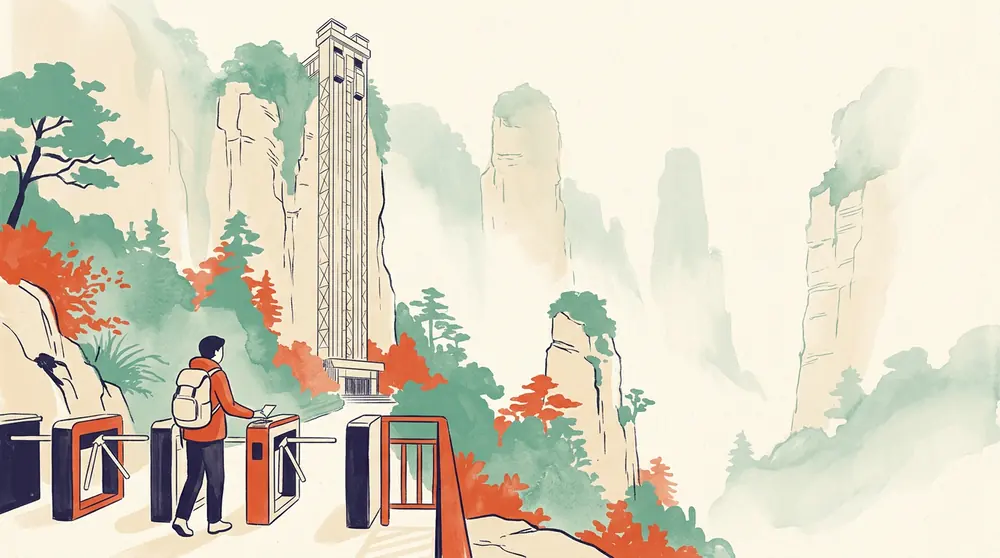
The park operates under a strict "every entry needs a booking" (凡进必约) policy using real-name, time-slot, per-station reservations. Visitors without a reservation cannot enter.
This affects how you plan your mornings in three ways:
- You must pick your gate and arrival window. The park has multiple entrance stations, and your reservation is tied to a specific station and time slot. Normal ticket station hours run from 7:30 to 17:00, widening to 6:30 to 17:00 during the National Day holiday week.
- Every re-entry requires a fresh reservation. The 4-day validity starts on the day of your first scan, so entering late in the afternoon may use up part of your pass. Check on the day how the 4 days are counted; if you arrive in the afternoon, wait until the next morning to enter. You cannot simply walk back through any turnstile on days two, three, or four. Each re-entry within the 4-day window needs its own station and time-slot reservation, so reserve your next morning's gate and slot as soon as your route is set.
- Face recognition replaces paper checks. At the gate, turnstiles verify your entry by matching a live face scan against the passport or ID linked to your booking. The notice allows visitors without a physical Chinese ID card to self-register a face scan, though foreigners should always carry their original passport rather than relying on a phone photo.
How a foreigner books the ticket
Foreigners can buy and reserve with a passport; the official visitor notice explicitly lists passports alongside Chinese IDs and Hong Kong or Macao permits as valid for both gate purchases and online reservations. Avoid unofficial street touts outside the gates, who cannot issue valid real-name reservations. You do not need a Chinese phone number if you choose the right booking path:
- The official WeChat mini program. Book directly through the "张家界旅游小助手" WeChat mini program using your passport. The interface is in Chinese and requires an active WeChat account, making this best for travelers comfortable using built-in translation tools.
- Trip.com or a similar international platform. Pay with a foreign card in English and receive a voucher or QR code, usually for a small premium over the gate price. Make sure your reservation specifies your day-one entrance station and time slot. Our attraction ticket guide explains how passport bookings work on these platforms.
- At the gate ticket windows. Entrance windows sell the pass directly against your passport with no booking markup. However, because time slots can run out on peak days, showing up unbooked during holidays or busy weekends can leave you locked out of your preferred morning window.
- A tour or Klook package. Travelers who want a guide, hotel pickup, or someone else to manage the daily re-entry reservations and lift queues can browse Zhangjiajie tours on Klook (the link opens Klook's main page, where you can search for Zhangjiajie). Third-party packages that bundle the pass with lifts can cost more than the sum of the official fares, so add up the table prices first to see what you are paying for convenience.
Beyond your original passport, carry a working data connection and small cash. Signal inside the valleys can be weak when pulling up booking codes or making next-day reservations (see our eSIM guide to set up mobile data before arriving). While main ticket windows handle standard digital payments, small snack stalls and kiosks inside the park do not always accept foreign bank cards.
Cable cars and the Bailong Elevator: how to choose
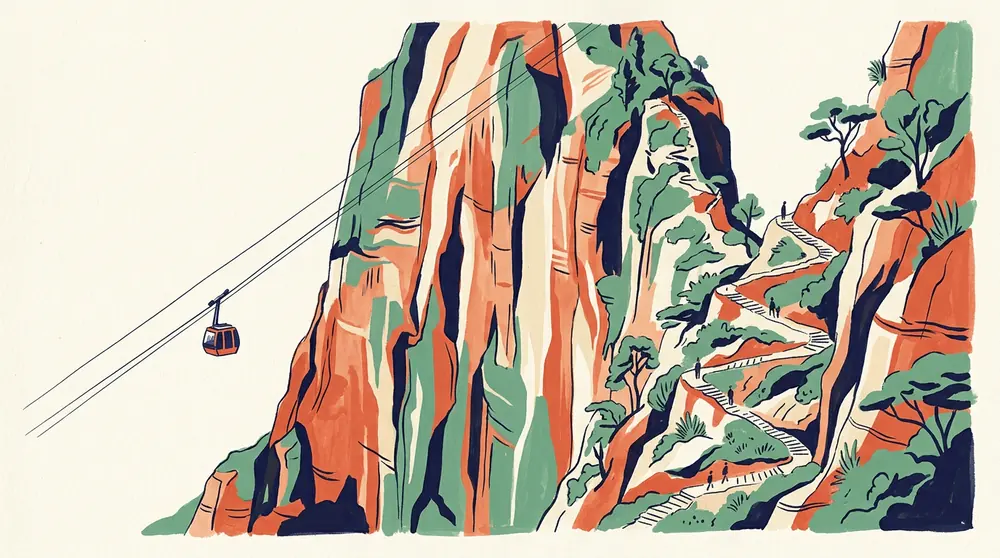
Because the sandstone pillars rise vertically from the valley floor, the three cableways and the Bailong Elevator are functional transit rather than optional sightseeing rides. Riding every lift both ways quickly exceeds the price of the park pass itself.
Two rules govern how you buy them. First, lift tickets are strictly direction-controlled: an "up" ticket works only at the bottom station going upward, a "down" ticket works only going downward, and the turnstile gates enforce the direction. Second, lift tickets can sell out on busy days. Pick your walking direction before buying, because you cannot use an upward ticket to ride down if you change your mind on the ridge, and buying a return ticket commits you to riding both directions on the same lift.
| Add-on | Worth it when | Skip it when |
|---|---|---|
| Bailong Elevator | You want to reach Yuanjiajie quickly and save your legs for walking the plateau | You enjoy stair climbs and have 4 days |
| Tianzi Mountain cable car | You are doing Tianzi Mountain and want an easy descent or ascent | You are short of money and happy to hike |
| Yangjiajie cable car | You want the quiet side of the park with less hiking | You have already used two lifts that day |
| Ten-Mile Gallery train | You have kids, bad knees or limited time on the valley floor | You plan to walk the gallery slowly |
For most fit travelers, the smartest trade-off is the one-way split: pay to ride up the cliff on the Bailong Elevator or the Tianzi Mountain cable car, walk across the upper plateau between viewpoints via the eco-buses, and either hike down or take a single downward cable car at the end of the afternoon. Two one-way tickets on different lifts (for example, up Bailong Elevator and down Tianzi Mountain cable car) cost roughly the same as a return ticket, roughly halve the cost of riding everything both ways, and let you cover a loop without retracing steps.
How many days to budget, when to visit, and getting there
Although the pass covers four days, a two-night stay giving two full days inside the park is the sweet spot for most itineraries. A logical split puts Yuanjiajie and the Avatar pillar on Day 1, followed by Tianzi Mountain and Golden Whip Stream on Day 2. That leaves Days 3 and 4 free for separate attractions like Tianmen Mountain or the Grand Canyon Glass Bridge, or gives you a weather buffer if heavy rain closes trails or fogs out the upper cliffs on your first morning.
April to May and September to October usually bring the best balance of weather, when mist clings to the sandstone pillars without the heavy downpours that shut trails. Avoid major mainland holiday weeks, especially Spring Festival, Labor Day, and National Day, when queues build early and slots or lift tickets sell out. Check the exact dates in our China public holidays 2027 guide before booking flights.
Travelers arrive via Zhangjiajie Hehua Airport or Zhangjiajie West high-speed rail station. If you are coming from the coast, our Shanghai to Zhangjiajie guide compares flight and train options from both Shanghai and Beijing. While Tianmen Mountain sits right in Zhangjiajie city, the National Forest Park lies outside town; most visitors stay in Wulingyuan district to sleep near the main forest park entrance station.
FAQ
How much are Zhangjiajie National Forest Park tickets?
The 4-day combined pass with in-park eco-buses is ¥240 (about US$36), an entrance-only ticket is ¥168, and the annual pass is ¥298, per the 2026 official Zhangjiajie tourism notices; a ¥3 insurance fee is optional. Cable cars and the Bailong Elevator cost extra.
Do I need my passport to enter Zhangjiajie National Forest Park?
Yes, passports are accepted for real-name purchase and booking, and gates verify entry by face recognition against your ID. You must also make a time-slot and station reservation for your first entry and for each re-entry during the 4-day pass validity.
Is the Bailong Elevator included in the park ticket?
No. The Bailong Elevator costs ¥65 one way or ¥130 return, and tickets are direction-controlled for either upward or downward travel. The ¥240 park ticket covers only the in-park eco-buses.
Is Tianmen Mountain included in the Zhangjiajie ticket?
No. Tianmen Mountain is a separate park with its own one-day ticket listed at ¥288 on the official notice. The Grand Canyon glass bridge is also a separate ticket.
Can I buy Zhangjiajie tickets at the gate?
Yes, ticket windows at the park entrances accept passports and sell the 4-day pass from 7:30 to 17:00 normally (6:30 to 17:00 during National Day week). Because entry requires a time-slot reservation that can sell out on peak days, booking ahead via the official WeChat mini program or an international platform is safer during busy periods.
More guides like this
- DestinationsZhangjiajie Glass Bridge 2026: Tickets, Tips & Visitor Guide
- DestinationsGolden Whip Stream Zhangjiajie: Complete Hiking Guide (2026)
- DestinationsAvatar Mountains China: Zhangjiajie Visitor Guide
- DestinationsChengdu Panda Base 2026: Tickets (¥55), Hours & Tips
- DestinationsForbidden City Tickets: How Foreigners Book (2026)
- DestinationsHarbin Ice Festival 2026-27: Dates, Tickets, What to Wear
Rules and apps in China change often. Spotted something out of date? Tell us at [email protected]. Published November 7, 2026.