Does Apple Pay Work in China? What Tourists Can Use Instead
Apple Pay works in China mainly with UnionPay-linked cards. Foreign cards rarely tap through, so use Alipay or WeChat Pay, with fees and a backup plan.
Updated 8 min readCSK Team
On this page11 sections
- The Short Answer by Situation
- What Apple Says About Apple Pay in China
- Why Apple Pay Is Not the Norm in China
- Does a Physical Foreign Card Work?
- What to Set Up Instead
- Cash Is Your Third Layer
- Step-by-Step Setup Plan Before You Fly
- Edge Cases and Common Problems
- What About Apple Watch and Google Pay?
- The Bottom Line
- FAQ
Quick answer: Apple Pay exists in mainland China, but it is built around UnionPay and mainland bank cards. A foreign Visa or Mastercard in your home Apple Wallet will rarely tap through at Chinese shops, and most small vendors only take QR codes. Set up Alipay or WeChat Pay with your foreign card before you fly, and carry a little cash.
Most visitors ask this because they have used Apple Pay everywhere at home. China is different. The everyday payment tools are QR-code wallets, and the card terminals that do exist are set up for the local network. This guide explains what Apple's own pages say, where a foreign card might work, and what to set up instead.
The Short Answer by Situation
Acceptance depends on the shop and the terminal, so treat this table as a rough guide, not a guarantee.
| Situation | Foreign-card Apple Pay | What to use instead |
|---|---|---|
| Street vendors, markets | Not realistic | Alipay or WeChat Pay QR, or cash |
| Local restaurants | Rarely | Alipay or WeChat Pay |
| Convenience stores | Rarely | Alipay or WeChat Pay |
| Taxis | Rarely | Alipay or WeChat Pay, or DiDi in-app |
| Metro and buses | Not for foreign cards | Alipay or WeChat transit QR codes |
| International hotel chains | Often possible at the front desk | Physical card or Apple Pay, ask first |
| Apple Stores, big malls, duty free | Sometimes | Physical card as backup |
| Online shopping | Very limited | Alipay |
If you carry a card with a UnionPay logo, your odds are better, since UnionPay is the local network.
What Apple Says About Apple Pay in China
Apple's support page on where to use Apple Pay says that in mainland China you should use it wherever you see the Apple Pay mark, the UnionPay QuickPass logo, or the China T-Union logo. That tells you what the terminals are built for: UnionPay and the national transit card, not Visa or Mastercard tap.
Apple also notes that in mainland China, some international Mastercard and Visa cards can be added to Wallet from the issuer's app and used for cross-border transactions, and you should check eligibility with your card issuer. That feature is for people living in mainland China who want to spend abroad. It does not mean your foreign card will tap at a Chinese terminal.
Apple Pay on the web in China is limited too. Apple's page says that in mainland China you can use it on the web only in Safari on compatible iPhone and iPad models.
Why Apple Pay Is Not the Norm in China
QR codes got there first
Alipay started in 2004 and added QR payments later. WeChat Pay launched in 2013. Apple Pay arrived in China in 2016. By then QR codes were already how shops and street vendors took payment.
The technology is different
| Apple Pay (NFC tap) | QR code wallets | |
|---|---|---|
| Merchant equipment | A contactless terminal | A printed code or a phone |
| Typical card network | UnionPay in China | Linked bank or foreign card |
| Works at tiny stalls | No | Yes |
| Works with a foreign card | Hit and miss | Yes, via Alipay or WeChat Pay |
A stall owner can print a QR code for almost nothing. A terminal needs hardware and a bank relationship. That is why QR codes spread to places NFC never reached.
Does a Physical Foreign Card Work?
Sometimes. The Shanghai government's payment guide for visitors says people with cards issued outside the mainland can pay directly at POS terminals that show the matching network logo. At participating merchants, logos for UnionPay, Visa, Mastercard, American Express, JCB, Diners Club or Discover may be accepted, depending on what the terminal displays. It also says some taxis with compatible terminals accept foreign cards, and tells visitors to look for the logo or ask the cashier.
Practical rules:
- Look for your card's logo on the door or the till before you order.
- If there is no logo, ask. A simple phrase works: show the card and say "能刷卡吗?" (can I pay by card?).
- Expect hotels, airports, big malls and international brands to be the most reliable.
- Do not plan a whole day around card acceptance. Smaller places often take only QR codes or cash.
Whether your phone's tap-to-pay works at the same terminal depends on the terminal, your card network and your issuer. Test it with a small purchase early in the trip instead of finding out at a ¥500 dinner.
What to Set Up Instead
Alipay, your main wallet
Alipay lets you link an international card, so the charge goes to your home card. Download it, sign up with your foreign phone number, add the card, and verify with your passport. Full steps are in our Alipay setup guide.
WeChat Pay, your backup
WeChat Pay sits inside WeChat. You need a WeChat account first, which may need an extra verification step. See our WeChat setup guide and the comparison in Alipay vs WeChat Pay for foreigners.
Fees and limits for foreign cards
| Item | What to expect |
|---|---|
| Payments of ¥200 or less (about US$30) | Generally no platform fee |
| Payments above ¥200 | 3% of the full amount. A ¥300 (about US$45) purchase costs about ¥9 (about US$1.35) extra |
| Your bank | May add its own 1% to 3% foreign transaction fee |
| Limits | Shanghai government guide: up to US$5,000 per transaction, US$50,000 per year. WeChat's help center lists ¥6,500 per payment, ¥50,000 per month and ¥65,000 per year. Check the limits in your own app |
Source for the fee and the dollar ceiling: the Shanghai government payment guide for visitors. Source for the WeChat figures: WeChat's help center page on international cards. Rules can change, so confirm in the app before a big purchase.
Convert prices with our CNY converter. At about 6.7 yuan to the dollar, ¥100 is roughly US$15.
Cash Is Your Third Layer
Keep some cash for the moments when a QR code will not scan or your phone is dead.
- Withdraw from ATMs that show your card's logo. The Shanghai guide says withdrawals with overseas cards are generally subject to a ¥3,000 (about US$450) per-transaction limit, some ATMs add restrictions, and your bank may set its own daily or monthly limits. See foreign cards at ATMs in China.
- Carry small bills for stalls and taxis. Chinese law requires shops to accept cash, though some do it reluctantly.
- Exchange tips are in our currency exchange guide.
Step-by-Step Setup Plan Before You Fly
- Two weeks out: Install Alipay and WeChat. Start registration while you still have your home number and Wi-Fi.
- One week out: Add your foreign card to Alipay and finish passport verification. Tell your bank you will use the card in China so the test charge is not blocked.
- Three days out: Add the card to WeChat Pay too. Check your daily and annual limits in each app.
- Packing: Bring a second card on a different network if you have one. Bring a power bank and keep your phone charged, because the whole system depends on it. See our pre-departure checklist.
- First day in China: Make one small purchase, such as a bottle of water, to confirm everything works. Withdraw a small amount of cash.
Edge Cases and Common Problems
| Problem | What to do |
|---|---|
| Card is declined when adding to Alipay | Call your bank to allow international online payments, then retry. Try a second card |
| Terminal shows a UnionPay logo only | Your Visa or Mastercard may not work. Use Alipay, WeChat Pay or cash |
| Phone dies | Carry cash and a charged power bank. A hotel front desk can often charge a phone |
| No mobile data | Alipay and WeChat need data to pay. Get an eSIM before you land, see China eSIM setup |
| Merchant refuses your QR code | Try the other app, show your payment code instead of scanning, or pay cash |
| Large purchase above your limit | Split the payment, or pay with a physical card at a store that shows your logo |
What About Apple Watch and Google Pay?
The same logic applies. Apple Pay on a watch needs a terminal that accepts the card on it. Alipay and WeChat have watch support in some versions, but check your own app, since features vary. Google Pay is not a practical option for foreigners in China, and Google services are blocked, so do not count on it. For other blocked services see our China firewall checker.
The Bottom Line
Apple Pay is not useless in China, but it is not the tool for a foreign visitor. UnionPay-based tap works for people with mainland cards. Visitors should set up Alipay first, WeChat Pay second, and carry a bit of cash. That combination covers almost everything from taxis to street food.
FAQ
Does Apple Pay work in China?
Yes, but mainly with UnionPay and mainland-issued cards. Apple's support page points to the Apple Pay mark, UnionPay QuickPass and China T-Union logos. A foreign Visa or Mastercard in your home Wallet rarely taps through at ordinary shops.
Can you use Apple Pay in China with a foreign card?
Sometimes at international hotels, airports and big malls, depending on the terminal and your issuer. Do not rely on it. Link the same card to Alipay or WeChat Pay instead.
Does China have Apple Pay?
Yes, it launched in 2016 and runs on UnionPay and local bank cards. It is a small part of everyday payments next to Alipay and WeChat Pay.
What is the best way to pay in China as a tourist?
Alipay with your foreign card, WeChat Pay as backup, and some cash. Foreign cards pay with no platform fee at ¥200 or less and 3% above that, plus any fee from your bank.
Can I use my physical Visa or Mastercard in China?
At terminals showing your card's logo, yes. The Shanghai government says visitors can pay directly at POS terminals with matching logos and withdraw cash at ATMs that show the logo. Many small shops only take QR codes. See can I use my debit card in China.
Need help with payments in China? The China Survival Kit includes step-by-step Alipay setup, payment guides, and backup solutions for when things go wrong.
Essential Apps for This Guide
All 19 apps →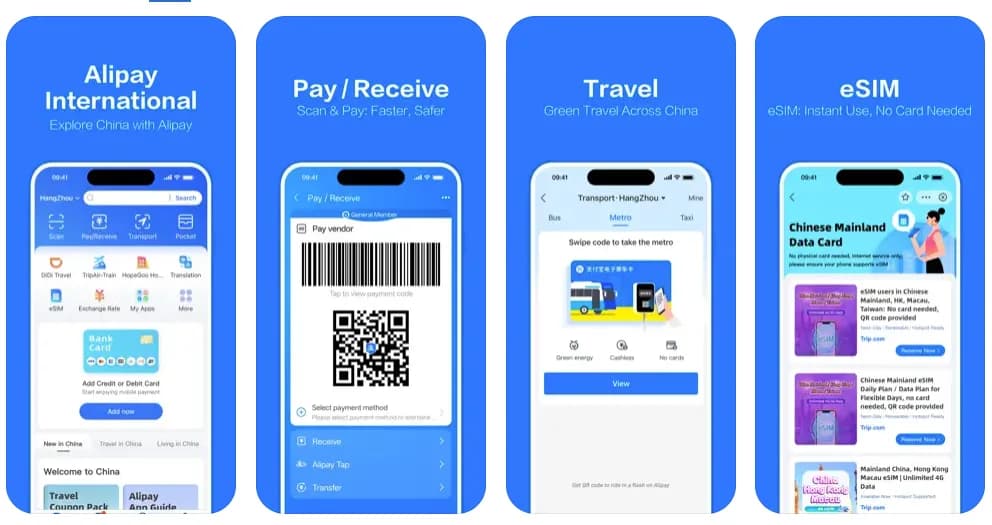

More guides like this
- Money & PaymentsAlipay vs WeChat Pay for Foreigners: Which to Use in 2026
- Money & PaymentsWeChat Pay for Foreigners: Link Your Card in 5 Steps (2026)
- Money & PaymentsAlipay Setup for Foreigners: Link a Foreign Card in 2026
- Money & PaymentsHow to Bargain in China: Negotiating Prices Like a Local
- Money & PaymentsTipping in China: Don't Do It — Here's Why (2026 Guide)
- Money & PaymentsCan I Use My Debit Card in China? Where It Works in 2026
Rules and apps in China change often. Guides are checked against official sources — see our editorial & verification standards. Spotted something out of date? Tell us at [email protected]. Published December 8, 2025.