Chinese New Year 2027: Date, Holiday and Travel Guide
Chinese New Year 2027 is Saturday 6 February, the Year of the Goat. The holiday runs 5 to 13 Feb. What closes, Chunyun rush, booking tips and whether to go.
Updated 18 min readCSK Team
On this page12 sections
- Chinese New Year 2027 dates at a glance
- How the 9-day break shapes your trip week by week
- Chunyun: the Spring Festival travel rush
- Booking strategy: flights first, trains on the 15-day clock
- What closes and what stays open
- Hotel prices and where the crowds go
- Best cities, temple fairs and seasonal events
- Traditions, etiquette and the WeChat red-packet trap
- Should you travel to China at Chinese New Year?
- Entry rules for February 2027
- Connectivity, weather and packing
- FAQ
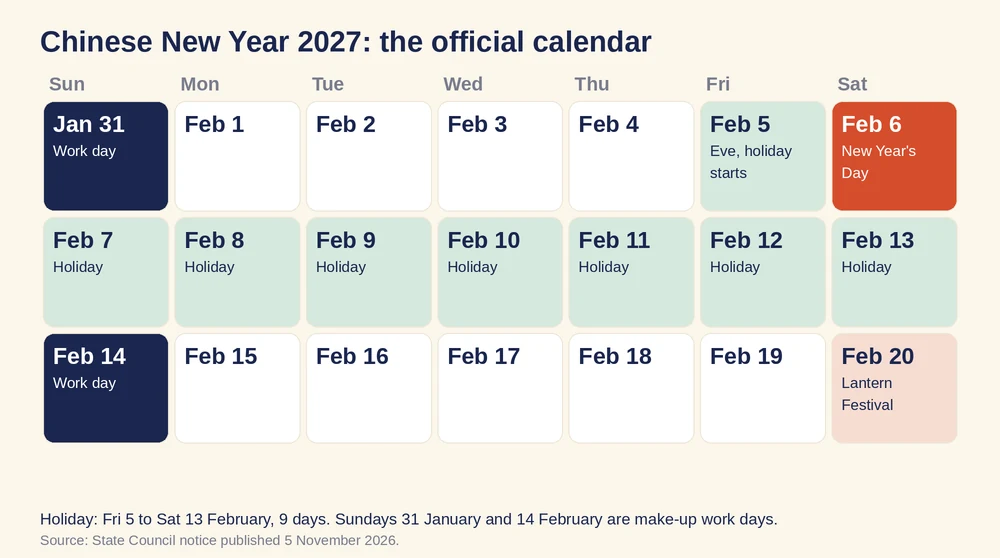
Quick answer: Chinese New Year 2027 (also called Lunar New Year or Spring Festival) falls on Saturday, 6 February 2027, starting the Year of the Goat. China's official public holiday runs 9 days from 5 to 13 February, with make-up work days on Sunday 31 January and Sunday 14 February. The 15th day of the first lunar month is the Lantern Festival.
Chinese New Year shapes a trip to China more than any other week on the calendar. Long-distance trains fill up minutes after tickets go on sale, family-run noodle shops shutter for days, and domestic tourists pack major sights by the middle of the holiday week. Yet big cities such as Beijing and Shanghai can feel unusually calm during the first few days of the break, provided you already have a bed and do not need an intercity rail ticket.
For the full 2027 calendar, see China public holidays 2027. For a broader breakdown of crowd patterns, closures and route planning, read traveling in China during Chinese New Year. What follows covers the confirmed 2027 dates, the zodiac calendar, the Chunyun transport rush, and the sequence in which you should lock down visas, flights and trains.
Last checked: 5 November 2026, with rail and city event announcements checked November 2026. Official holiday dates come from the State Council holiday notice published on 5 November 2026 and reported by news.cn.
Chinese New Year 2027 dates at a glance
| Item | Date | Notes |
|---|---|---|
| Lunar New Year's Eve | Friday, 5 February 2027 | Family reunion dinner. Official holiday starts. |
| Chinese New Year (Spring Festival) | Saturday, 6 February 2027 | First day of the first lunar month |
| Official public holiday | 5 to 13 February (Fri to Sat), 9 days | State Council notice |
| Make-up work days | Sunday 31 January and Sunday 14 February | Offices and many schools work these days |
| Lantern Festival | Saturday, 20 February 2027 | 15th day of the first lunar month |
| Zodiac | Year of the Goat (丁未 Dingwei, Fire Goat) | 羊 yáng |
Lunar New Year is also celebrated across East and Southeast Asia, though time-zone rules for the new moon can occasionally shift the observance by a day outside China. Within mainland China, 6 February 2027 is the official date.
Goat, Sheep or Ram?
English coverage splits three ways because the Chinese character 羊 (yáng) covers all three animals without distinction. HISTORY.com, the Farmers' Almanac and ChineseZodiac.com each list the sign as "Goat (also called Sheep or Ram)". We use "Goat" because it is the most widely used translation in English-language Spring Festival coverage.
People born in 1991, 2003 and 2015 share the sign, though the cutoff is the lunar new year rather than 1 January. Someone born in January 2003 before 1 February falls under the previous Year of the Horse.
How the 9-day break shapes your trip week by week
Because the first normal weekday is Monday 15 February, many salaried workers bridge the gap with annual leave, stretching the travel peak at both ends.
Where you are on specific dates matters much more than the holiday label itself:
- 29 January to 4 February: Outbound travel from major economic hubs builds steadily. Many migrant workers and office staff leave big cities starting about 4 days before New Year's Eve. Stations and airports get noticeably busier each day, while city centers stay open as normal.
- 5 to 8 February: The quietest stretch inside major cities. Millions of residents are away in their hometowns or indoors at family dinners. Street traffic drops, neighborhood shops close, and city walks in places like Beijing or Shanghai are calmer than usual.
- 9 to 13 February: Domestic leisure travel hits its ceiling. Once family obligations wrap up over the first two or three days, domestic travelers head out on vacation. Major scenic spots, theme parks and famous temple districts draw heavy crowds.
- 13 to 16 February: The return rush. Trains and flights heading back into tier-one cities fill to capacity because offices reopen on Sunday 14 February and Monday 15 February.
Chunyun: the Spring Festival travel rush
Chunyun (春运) is the 40-day Spring Festival transport window when hundreds of millions of journeys take place across China's rail, road, air and water networks. The central government issues an official operating plan with exact dates every year.
| Season | Official dates | Length | Source |
|---|---|---|---|
| 2026 | 2 February to 13 March | 40 days | Transport ministry plan, reported by CNR on 24 January 2026 |
| 2027 | Not yet published (as of 5 November 2026) | Usually 40 days | See estimate below |
As of 5 November 2026, no official 2027 Chunyun notice had been published. Because the 2026 plan was released in late January 2026, the 2027 dates are unlikely to appear until January 2027. The standard formula runs 15 days before New Year's Day and 25 days after. Applying that pattern to 6 February 2027 puts the estimated window at roughly 22 January to 2 March 2027. Some Chinese websites already list "confirmed" 2027 dates, but treat any date as a projection until the transport ministry publishes its plan.
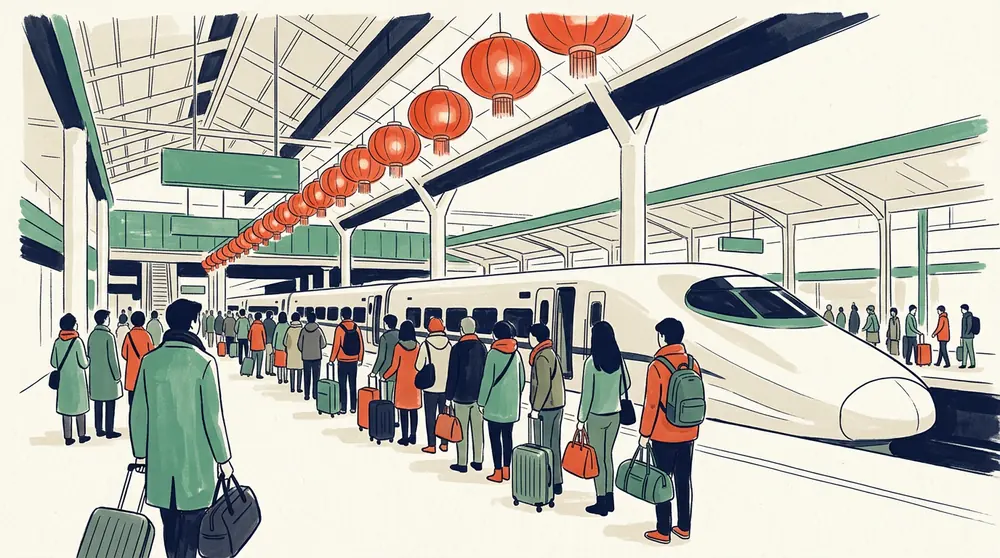
For a foreign visitor, Chunyun is an intercity problem rather than a local transit problem. City subways keep running smoothly, and major high-speed lines such as Beijing to Shanghai stay on their normal timetables. The catch is seat inventory and station processing time. The hardest days to move between cities are the 2 to 3 days before New Year's Eve (outbound from major cities) and the final days of the holiday (inbound to major cities). Even when you hold a confirmed ticket, security and ID checks at stations and airports take longer than usual, so build extra buffer time into every departure.
Railway hubs occasionally roll out extra seasonal services during the rush. According to a Guangzhou government booking guide (checked November 2026), the 2026 season included a "Light Travel" door-to-station luggage service at 111 major stations (including Harbin) and a pilot program for bringing ski equipment on board selected Northeast China routes. Whether those specific baggage pilots continue in 2027 is not yet confirmed.
Booking strategy: flights first, trains on the 15-day clock
The biggest planning trap during Spring Festival is the mismatch between airline and railway booking windows. You can buy flights months in advance, while train tickets are locked until two weeks before travel. If you plan a multi-city route that depends on specific trains during peak days, you will not know whether you got seats until late January or early February.
To avoid getting stranded between cities, decide in this order:
- Lock down international flights and any non-negotiable long-distance domestic flights first.
- Design your overland route so you are not forced to take a long train ride on 2 to 4 February or 12 to 15 February.
- Book flexible hotels that allow free cancellation in case you need to swap a sold-out train leg for a flight or change the order of two cities.
Use the pre-departure checklist to track your documents, payment setups and reservation deadlines in one place.
Trains and the 15-day release window
Per a Shanghai government notice on Spring Festival rail sales (checked November 2026), China's official rail platform 12306 sells train tickets up to 15 days before the departure date (counting the departure day itself, which means 14 calendar days prior). In the Guangzhou government booking guide for the 2026 holiday, tickets for 15 February went on sale on 1 February, tickets for 23 February opened on 9 February, and tickets for 3 March opened on 17 February. Under that 15-day rule, tickets for the first day of the holiday (Friday 5 February 2027) should open on Friday 22 January 2027, pending the official 2027 rail notice.
Foreign travelers can buy tickets at a station window with a passport, through the official 12306 app or website (which has an English setting), or via an agency platform such as Trip.com. At the station, you no longer need a paper ticket to board: you can swipe your passport at the automatic check-in gates or show it to staff at the manual lane. For a full walkthrough of registration and booking, see how to buy train tickets in China as a foreigner, and check Trip.com train seat selection if you want to pre-order or pick seat types through an agency.
During the Spring Festival window, desirable departure times sell out within minutes of release. Keep these fallback options ready when tickets open:
- Look at departures earlier in the morning or later at night on the same corridor.
- Check second-class seats if first-class is gone, or vice versa, as cheap seats on trunk lines go early.
- Search routes with a single transfer rather than only direct trains.
- Never wait until travel day to buy a ticket at the station window.
If you book the wrong train in the rush to check out, 12306 introduced a grace period for tickets dated from 2 February 2026 onward: passengers could claim a full online refund if they cancelled within 30 minutes of purchase and at least 4 hours before departure (checked November 2026; check the 12306 app before booking to see whether the same rule applies in 2027).
Domestic flights
Airlines do not cap sales at 15 days, which makes flying a useful backup when trains look risky. Domestic fares are more volatile than normal during the holiday week. Compare fares across several consecutive days before committing.
When flying domestically, remember that Chinese airport security strictly enforces battery rules at transfer and departure checkpoints. Read China power bank rules for flights and trains so your spare battery is not confiscated in a holiday security queue.
What closes and what stays open
China does not shut down across the board for nine days. Instead, closures cluster in the first 3 to 5 days, from New Year's Eve on 5 February through roughly the third day of the lunar year on 8 February, and split sharply between state or corporate services and small family businesses.
| Category | During the holiday |
|---|---|
| Government offices, banks, embassies and visa offices | Closed for the holiday. Branch hours vary. |
| Small shops, local restaurants, small factories | Many close for days or weeks. Owners go home. |
| Large malls, chain stores, hotel restaurants | Mostly open, sometimes shorter hours |
| Convenience stores and delivery apps | Open, but delivery can be slower and couriers fewer |
| Major sights (Forbidden City, Great Wall, museums) | Open, with timed tickets and large crowds. Check each site for closure days. |
| Hotels | Open |
| Public transit | Runs, and may run extended hours in some cities |
The contrast is sharpest at mealtimes. Independent hole-in-the-wall dumpling shops, neighborhood cafes and street stalls often paste red paper over their doors and leave town for a week or two. Shopping malls, international chains and hotel dining rooms stay open, sometimes on slightly shortened hours. For New Year's Eve on 5 February, many sit-down local restaurants either close early for staff dinners or take advance bookings only for multi-person family set menus. Solo travelers and couples should reserve through their hotel or rely on mall restaurants that evening.
Sort out your daily logistics before 5 February:
- Set up and verify your mobile payment wallets before you board your flight to China using the Alipay and WeChat Pay guide, and withdraw a backup stash of cash before bank branches close for the holiday.
- Reserve timed-entry slots for major museums and monuments as soon as their booking windows open. Even when streets look quiet on 6 and 7 February, headline sights fill their daily quotas quickly. Follow the steps in how to book attraction tickets in China and check each venue's official notice for single-day holiday closures.
- Pack basic cold and stomach medication. Pharmacies and large public hospitals stay open throughout the break, but clinic waiting times can be long.
Hotel prices and where the crowds go
No official source publishes advance hotel tariffs for 2027, so budget around the two-speed pricing split that characterizes every Spring Festival.
Leisure resorts and classic domestic holiday destinations, such as Harbin for snow, Sanya in Hainan for warmth, Yunnan, Guilin and smaller historic water or mountain towns, see peak domestic demand during the 9-day break. Room rates climb and the best properties sell out early.
Big migrant-sending cities such as Beijing and Shanghai often work in reverse during the first days of the holiday. With business travel paused and residents away from 5 to 8 February, some business-oriented hotels discount their rates. Do not assume every hotel is cheap or expensive; check actual rates for your exact dates across the platforms in hotel booking apps for foreigners and the Trip.com booking guide. Paying slightly more for a room with free cancellation is smart insurance while you wait for the 15-day train ticket window to open.
Best cities, temple fairs and seasonal events
Where you choose to base yourself determines whether you experience Spring Festival as an intense winter carnival or a relaxed big-city break.
| Choice | Why it suits Spring Festival |
|---|---|
| Beijing or Shanghai | Quieter streets on the first days, many cultural sites still open |
| Chengdu | Relaxed pace, pandas, teahouses; check the closure days of individual venues |
| Harbin | Ice and snow season in full swing; see the Harbin Ice Festival guide |
| Hainan, Yunnan | Warmer weather, but domestic holiday crowds are heavy and prices are high |
City governments usually publish their exact 2027 festival schedules in January, so 2027 dates and ticket prices are not yet announced. However, 2026 official schedules show how events cluster across the first week of the lunar year and continue up to the Lantern Festival:
- Temple fairs (庙会 miàohuì): Parks and temple grounds host food stalls, folk performances and craft markets. Beijing and Chengdu are well known for them. In 2026, Beijing's Ditan Park, Longtan Park and Changdian temple fairs ran for the first seven days of the lunar year (17 to 23 February 2026, with 17 February being New Year's Day), charging 30 yuan for adult entry at Ditan and Longtan and 15 yuan for visitors under 18 or over 60 (Visit Beijing, checked November 2026).
- Lantern displays and night tours: Large illuminated installations in parks, fortresses and historic districts often start before New Year's Eve and run all the way to the Lantern Festival on the 15th day of the lunar month. In Beijing's 2026 holiday event lineup (checked November 2026), the Yuanmingyuan park tour ran from 7 February to 3 March, Wanping Fortress markets ran from 15 February to 3 March, and Badaling hosted night performances from 16 to 23 February.
- Lion and dragon dances: Common across southern China, particularly in Guangdong and historic commercial quarters.
- Fireworks: Rules vary by municipality, and many central urban districts restrict or ban personal fireworks. On 21 February 2026, Xinhua reported that the State Council work-safety office ordered a nationwide safety overhaul on fireworks sales and discharge, prohibiting discharge in designated no-fire zones and densely populated areas (checked November 2026). What you see and hear will depend on local district rules.

Traditions, etiquette and the WeChat red-packet trap
Understanding a few household customs helps if you are invited to a meal or staying in a neighborhood where families celebrate:
- Reunion dinner: Families gather on New Year's Eve (5 February). Dumplings are standard across northern China, while rice cakes and whole fish are traditional in the south.
- Red decorations: Doorways are framed with red lanterns, paper cuttings and calligraphy couplets (春联 chūnlián). You will often see the character 福 (fú, good fortune) pasted upside down on doors, a play on words because the Chinese phrase for "upside down" sounds like "arrived".
- Holiday cleaning: Families clean their homes thoroughly before New Year's Eve and avoid sweeping during the first days of the new year, since sweeping then is said to brush away incoming luck.
- Greetings: 新年快乐 (xīnnián kuàilè, Happy New Year) works everywhere, and 恭喜发财 (gōngxǐ fācái, wishing you wealth) is another safe seasonal greeting.
- Visiting a home: Bring a small gift such as fruit, tea or sweets. Wrap gifts in red or festive colors rather than all white or black, and never give clocks, which carry an unlucky association in Chinese culture.
- Midnight noise: Where fireworks are permitted or set off in outer districts, the noise begins on New Year's Eve and peaks around midnight. Pack earplugs if you are a light sleeper.
Red envelopes (红包 hóngbāo) and WeChat Pay limits
Physical red envelopes stuffed with cash are given by married adults and elders to children and unmarried younger relatives. As a foreign visitor, you are not expected to hand them out. If a host family gives you one, accept it with both hands, thank them, and follow your host's lead before opening it.
In daily life, Chinese friends also exchange digital red packets on WeChat throughout the holiday, which leads to a common payment trap for foreigners. WeChat Pay linked to an international bank card does not support red packets or peer-to-peer money transfers (per WeChat Help). You can pay merchants by scanning codes, but you cannot send a red packet or split a restaurant bill via a WeChat transfer. If a Chinese friend sends you a digital red packet, you will not be able to claim and spend those funds without a Chinese-linked bank account. Let friends know in advance and settle shared bills in cash or by paying the merchant directly. For full details on what international cards can and cannot do, read WeChat Pay for foreigners.
Should you travel to China at Chinese New Year?
Spring Festival is neither a reason to cancel a trip nor a normal sightseeing week. Whether it works depends on how rigid your route is.
| Good fit | Poor fit |
|---|---|
| You have flexible dates and are happy with festive crowds | You must use fixed rail connections on 1 to 3 February or 12 to 16 February |
| You want to see traditions, lights and temple fairs | You rely on small family restaurants or small shops |
| You are staying in one city or one region | You want an easy multi-city itinerary on trains |
| You have a visa sorted already | You need a visa processed through an embassy in the holiday weeks |
If your schedule is flexible, two windows offer the smoothest trip: spend the quiet opening days (5 to 8 February) inside a major city such as Beijing or Shanghai before moving on, or arrive after 14 February, when offices reopen, return trains clear out and hotel rates ease. Staying through Saturday, 20 February lets you catch the Lantern Festival displays without the peak Chunyun outbound crunch.
Entry rules for February 2027
Pay close attention to visa expiration dates before locking in February 2027 flights. China's 30-day unilateral visa-free policy for 48 of the 50 listed countries is currently scheduled to run until 31 December 2026, and as of 5 November 2026, no extension into 2027 had been announced. By contrast, the 240-hour visa-free transit rule (covering 57 countries and requiring a confirmed onward ticket to a third country or region) is not tied to that 31 December date.
Because February 2027 falls five weeks after the current 30-day visa-free cutoff, travelers relying on unilateral visa-free entry should check China visa-free entry in 2027 and the visa checker, and confirm current rules with a Chinese embassy or the National Immigration Administration before buying non-refundable tickets. Remember that Chinese embassies and visa centers close during the 5 to 13 February holiday week, so any required visa application must be completed well before late January.
Before flying, foreign visitors can also complete the official Online Arrival Card free of charge through National Immigration Administration channels; avoid third-party lookalike websites that charge fees for the form.
Connectivity, weather and packing
Airport arrival halls and urban cell networks are heavily loaded during the Spring Festival rush. Install and configure your travel eSIM before departure so your map, translation and payment apps work the moment you land. Compare your options in China SIM vs eSIM. Some links on this page are affiliate links, which means we may earn a commission at no cost to you. A travel eSIM such as Saily is one option to set up before you fly; test both your data connection and your payment apps before you need them at the airport rail counter.
February weather varies sharply by latitude. Northern cities sit below freezing, bitterly so in Harbin and cold and dry in Beijing, while Shanghai and Chengdu are cool and damp, where lack of central heating indoors can make evenings feel colder than the thermometer suggests. Only southern destinations such as Guangzhou, Hainan and parts of Yunnan offer mild daytime weather. Check the China packing list for winter layering advice, and verify your chargers with the power adapter tool.
FAQ
When is Chinese New Year 2027?
Chinese New Year 2027 falls on Saturday, 6 February 2027. Lunar New Year's Eve is Friday, 5 February, and the Lantern Festival closes the fifteen-day celebration on Saturday, 20 February.
What animal is Chinese New Year 2027?
It is the Year of the Goat (丁未 Dingwei, the Fire Goat). Because the Chinese character 羊 (yáng) refers to goats, sheep and rams alike, English sources use all three words for the same zodiac sign.
How long is the Chinese New Year holiday in 2027?
China's official public holiday runs for 9 consecutive days from Friday, 5 February to Saturday, 13 February 2027. Offices and schools work on Sunday, 31 January and Sunday, 14 February as make-up work days.
When does Chunyun 2027 start?
Official 2027 Chunyun dates had not been published as of 5 November 2026 and are usually announced in January. Because the 40-day rush typically starts 15 days before New Year's Day, it is estimated to run from roughly 22 January to 2 March 2027 until the transport ministry issues its plan.
Is Lunar New Year 2027 the same as Chinese New Year?
In China, both terms refer to the same date: Saturday, 6 February 2027. Lunar New Year is the broader English term that also covers celebrations across other Asian countries, where time-zone differences for the new moon can occasionally place the holiday a day apart.
Is it a bad time to visit China?
It is a crowded and logistically demanding week rather than a closed one. Major attractions, hotels and public transit stay open and big cities can be pleasantly quiet from 5 to 8 February, provided you book trains on the 15-day release clock and expect small family restaurants to close.
More guides like this
- Trip PlanningChinese New Year 2027 Travel: Dates, Closures, Crowds
- Trip Planning7-Day China Honeymoon Itinerary 2026: Day-by-Day Plan
- Trip PlanningBeijing vs Shanghai: Which City Should You Visit? (2026)
- Trip PlanningChina Tours and Packages: Types, Prices, Red Flags (2026)
- Trip PlanningChina Public Holidays 2027: Official Dates and Travel Tips
- Trip PlanningChina in Summer: Surviving the Heat (June-August Guide)
Rules and apps in China change often. Spotted something out of date? Tell us at [email protected]. Published November 7, 2026.