China Visa Photo Size: Exact mm and Pixel Requirements
China visa photo size is 33 x 48 mm printed, or 354 x 472 to 420 x 560 pixels as a 40 to 120 KB JPEG, on white. Official specs, checked Nov 2026.
Updated 11 min readCSK Team
On this page6 sections
Quick answer: A China visa photo is 33 mm wide by 48 mm high when printed on glossy photo paper, in colour, on a white or near-white background, taken within the last 6 months. Digital uploads require a 24-bit colour JPEG between 354 x 472 and 420 x 560 pixels, sized 40 to 120 KB. Head height is 28 to 33 mm. Checked 5 Nov 2026.
Photo mistakes are one of the most common reasons a Chinese visa application stalls, and if an application is declined because a photo fails the rules, the applicant bears responsibility. Because the system enforces two separate standards, the first step is understanding whether you are preparing a digital file for the China Online Visa Application (COVA) form at cova.mfa.gov.cn or a physical print to hand in with your passport. The rules below come from the photo specification published by the Chinese Visa Application Service Center (visaforchina.cn, file dated 1 Jun 2026), the Chinese Visa Application Service Center photo notice (dated 24 Nov 2016, in effect since 19 Dec 2016, with a page date of 26 Aug 2026), and the US Embassy COVA guidance (checked November 2026). Because an individual embassy or visa center has the final say and can ask for more, confirm the exact local requirements with the office handling your application.
Official China visa photo specifications
Printed photo (paper)
| Item | Requirement |
|---|---|
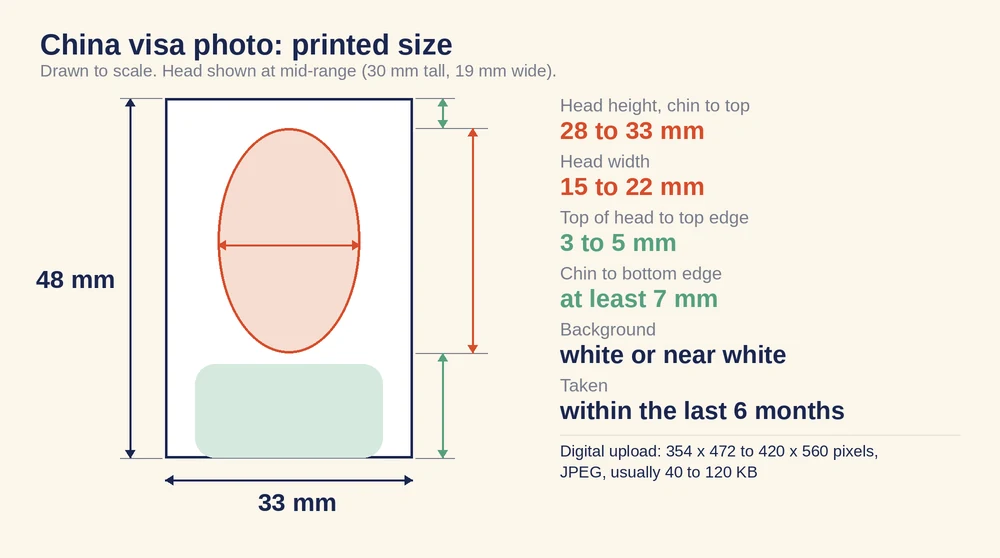
| Photo size | 33 mm wide x 48 mm high |
| Head width | 15 to 22 mm |
| Head height (chin to top of head) | 28 to 33 mm |
| Top of head to top edge of photo | 3 to 5 mm |
| Chin to bottom edge of photo | at least 7 mm |
| Background | White or close to white, no border or frame |
| Paper finish and condition | Glossy photo paper (not matte or plain paper), free of stains, scratches and creases |
| Age of photo | Taken within the last 6 months |
| Colour | Colour photo, not black and white |
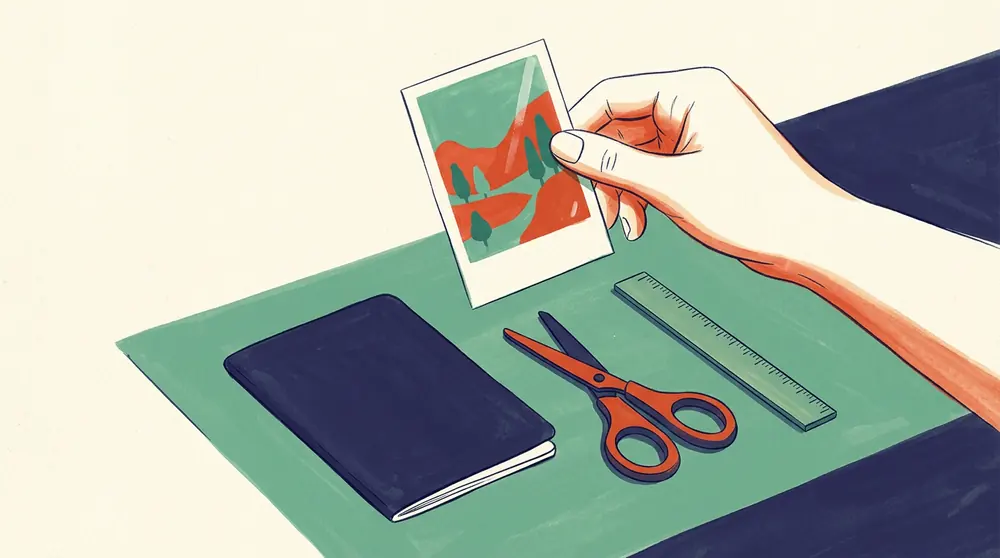
The Chinese Visa Application Service Center photo notice writes the dimensions as "48mm x 33mm", putting height before width. Do not let the reversed order confuse a photo clerk: the print is a vertical portrait rectangle of 33 mm wide by 48 mm high, never a horizontal landscape or a square. Paper choice matters just as much as the cut. The official notice specifies glossy photo paper and rejects matte finishes or plain paper, even when the millimetre measurements are exact.
Digital photo (online upload)
| Item | Requirement |
|---|---|
| Dimensions | Minimum 354 x 472 pixels, maximum 420 x 560 pixels (width x height) |
| Colour mode | 24-bit RGB true colour |
| Format | JPEG |
| File size | Usually 40 KB to 120 KB |
| Face width | 191 to 251 pixels for a 354 x 472 photo |
| Top of hair to top edge | 10 to 85 pixels |
| Eyes to bottom edge | At least 256 pixels |
| Distance between the eyes | More than 60 pixels |
The specification sheet calculates pixel positions using a 354 x 472 pixel image as the baseline. Sometimes a person's proportions or hairstyle make it impossible to satisfy both the top-of-hair margin (10 to 85 pixels from the top edge) and the eye height (at least 256 pixels from the bottom edge) at the same time. When those two numbers conflict, the specification states that eye position takes priority. In unusual cases where hair is very tall, part of the hair may be cropped off the top edge so the eyes stay at least 256 pixels above the bottom.
The COVA portal requires an image at least 354 x 472 pixels and includes a built-in crop tool where you position your head between the inner and outer guide ovals and click "Crop and Save". Follow the US Embassy COVA guidance on file types across the form: COVA accepts image files only, so PDF files and other document formats are rejected, and any upload box marked with red dashed borders is mandatory.
Face, posture and glasses rules
Beyond dimensions and file weight, an automated checker and a counter clerk both judge how your face fills the frame. According to the Chinese Visa Application Service Center photo notice, the visa center FAQ (February 2025), and the specification sheet, your portrait must follow these composition rules:
- Framing and posture: Face the camera directly with your face centered and your entire head and facial features complete, clear and visible. Head tilt cannot exceed 20 degrees left or right, or 25 degrees up or down.
- Expression and features: Keep a neutral expression with your eyes open, lips closed, and both ears visible. If your hair covers your ears, tuck it back before shooting.
- Lighting and colour: Exposure must be even and produce a natural skin tone, with no red eyes from flash, no over-exposure or under-exposure, and no shadows on either your face or the white background.
- Background and distractions: The frame must contain nothing else: no hands, toys, other people, edge borders, or "everyday life scenes". A holiday snapshot cropped around your shoulders will not pass.
- Eyeglasses: Both the visa center notice and the February 2025 FAQ allow eyeglasses, except for thick-rimmed, tinted, or glare glasses. Because even a slight reflection on clear lenses is a reason for rejection, taking your glasses off for the shot removes an easy point of failure.
- Head coverings: Hats and scarves are not recommended. A head covering is permitted only for religious reasons, and only if it does not hide any facial features.
Watch out for an outdated measurement trap when using third-party templates. Older web pages still quote a minimum head height of 20 to 33 mm, whereas the visa center notice and current FAQ require 28 to 33 mm. A template built around a 20 mm head will leave your face too small in the frame and trigger a rejection.
Why photos get rejected and how to prevent it
Most rejections happen because applicants treat a visa photo like a casual portrait or try to force an existing snapshot into the right rectangle. The visa center's sample page lists eight specific failure modes:
- Distorted or stretched proportions, which usually happen when someone squashes a square or wide photo to fit a 33 x 48 mm template instead of cropping it properly.
- Red eyes caused by direct camera flash.
- Closed eyes.
- An unnatural or crying expression, often an issue when photographing young children.
- Low resolution or motion blur.
- Exposure that is too dark or too bright, shifting the face away from a natural skin tone.
- Shadows cast across the face or onto the wall behind the subject.
- Torn, creased, scratched, or stained paper prints.
Several technical mismatches also fail the official specs: a head shorter than 28 mm, a coloured or patterned wall, a photo older than 6 months, or a digital JPEG that falls outside the 40 to 120 KB window or below 354 x 472 pixels. Most of these flaws are avoidable if you crop rather than stretch, turn off your camera flash in favour of indirect daylight, and check the pixel and kilobyte properties of your saved JPEG before starting the COVA form.
How to take or buy your photo: four options compared
Before you spend money on a visa photo, Check whether you need a visa at all: travelers who qualify for 240-hour visa-free transit may not need a photo, and our visa checker can tell you quickly. If you do need a visa, you do not have to pay for a specialist service. The options below run from cheapest to most expensive.
Option 1: phone photo plus the COVA crop tool (best for digital upload)
For the digital COVA step, a smartphone photo taken at home costs nothing and gives you time to reshoot until the lighting is right.
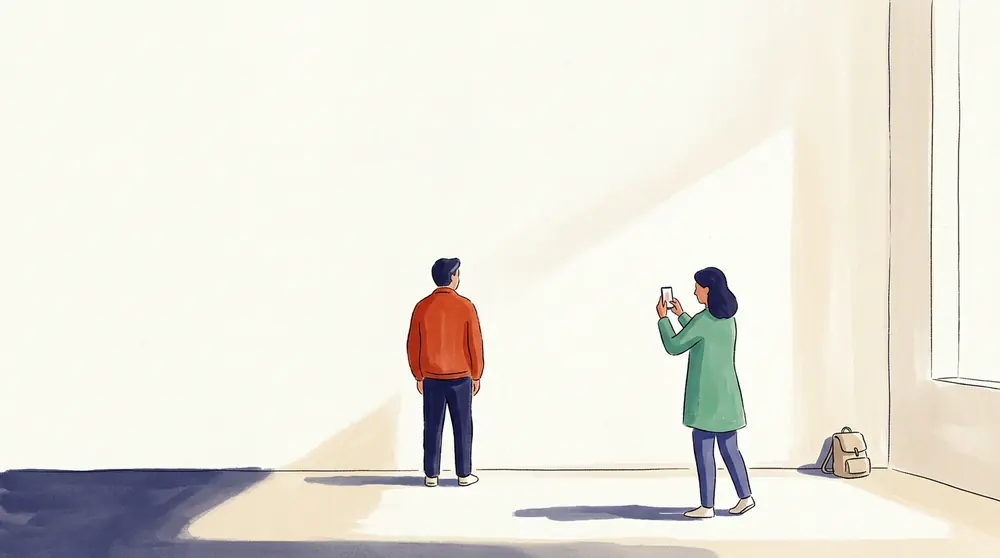
- Stand about 1 meter in front of a plain white wall in daylight, facing a window. Stepping a meter forward lets the wall fall out of your shadow, while facing the window lights both sides of your face evenly.
- Ask someone else to hold the phone upright at your eye level and take a straight-on shot with your mouth closed and both ears visible. Avoid taking an arm's-length selfie, which tilts the angle and distorts facial proportions.
- Shoot in standard colour with no filters and no beauty mode, as skin-smoothing software can alter facial features or skin tone.
- Upload the JPEG to COVA and drag and zoom inside the built-in crop tool until your head sits between the inner and outer guide ovals, then click "Crop and Save". The tool crops the image to 354 x 472 pixels and checks it automatically.
- If the system rejects the upload, check first for wall shadows or uneven lighting and reshoot against a cleaner background. Do not abandon the application if the automated checker keeps rejecting your file: the US Embassy COVA guidance states that if several upload attempts fail, you can continue filling in the rest of the online form and bring a compliant physical ID photo when you hand in your passport.
Option 2: a pharmacy, post office or photo shop (best for paper prints)
When you need physical prints, or if your home uploads failed, a local shop is more reliable than a home printer because the notice requires glossy photo paper. Ask specifically for a "China visa photo, 33 x 48 mm, printed on glossy photo paper". Never assume a standard domestic passport photo will pass. In the US, for example, passport photos are commonly square (2 x 2 inches, or about 51 x 51 mm), a completely different shape from the Chinese 33 x 48 mm portrait rectangle. Show the clerk the paper specifications table above before they shoot, insist on glossy paper rather than matte or plain stock, and bring a ruler or check the cut print against the 28 to 33 mm head height and 15 to 22 mm head width under good light before you pay and leave.
Option 3: a photo app or online tool
Some third-party apps and websites offer China visa photo templates. Because these are private tools rather than official visa center software, verify their output against the official pixel, kilobyte, and head-height numbers above, especially to make sure the tool uses the 28 to 33 mm head height rather than the outdated 20 mm minimum. Use them only for cropping a portrait; never upload passport scans or personal application data to a site you do not trust.
Option 4: a visa agent
A visa agency may bundle photo handling into its service fee. For most travelers, paying an agent just to handle a photo is an unnecessary expense unless you are already hiring that agency to submit your entire passport packet.
Pre-submission checklist
Before you upload your file to COVA or place your prints in your application folder, verify these points against the official rules:
- Format and size: Printed at 33 x 48 mm on glossy photo paper (never matte or plain paper, with no stains, scratches or creases), or saved as a 24-bit RGB JPEG at 354 x 472 to 420 x 560 pixels and 40 to 120 KB (never a PDF).
- Head proportions: Head height measures 28 to 33 mm (not the old 20 mm figure) and head width is 15 to 22 mm, with 3 to 5 mm above the head and at least 7 mm below the chin on paper; on a 354 x 472 digital file, the face is 191 to 251 pixels wide and the eyes sit at least 256 pixels from the bottom edge.
- Pose and appearance: Taken within the last 6 months against a white or near-white borderless background, facing straight ahead with a neutral expression, eyes open, lips closed, both ears visible, and no thick rims, tint, or lens glare if you keep eyeglasses on.
Once your photo is sorted, move on to the rest of the paperwork in our step-by-step guides: how to apply for a China visa covers the process for any nationality, and China visa for US citizens explains the specific steps for American applicants.
FAQ
What is the China visa photo size in mm?
The printed photo is 33 mm wide by 48 mm high on glossy photo paper. Your head must measure 28 to 33 mm from chin to top and 15 to 22 mm wide against a white or near-white borderless background.
What is the China visa photo size in pixels?
Online uploads to COVA require a 24-bit colour JPEG between 354 x 472 and 420 x 560 pixels (width x height), with a file size of 40 to 120 KB. Most applicants use 354 x 472 pixels, which is the size the built-in COVA crop tool produces.
Can I wear glasses in a China visa photo?
Eyeglasses are allowed according to the visa center notice and FAQ, except for thick-rimmed, tinted, or glare glasses. Because your eyes and ears must remain clearly visible and any lens glare can cause a rejection, taking your glasses off is the safer option.
Can I use my US passport photo for a China visa?
Check the dimensions first, because US passport photos are commonly a 2 x 2 inch (about 51 x 51 mm) square, whereas a China visa photo is a 33 x 48 mm vertical rectangle. A photo of the wrong shape or with a head outside the 28 to 33 mm height range can be rejected.
How recent must a China visa photo be?
According to the visa center specification and notice, the photo must have been taken within the last 6 months. Take a new photo if yours is older than 6 months or if your appearance has changed a lot.
More guides like this
- Visas & EntryHow to Get a Visa to Visit China: 2026 Application Guide
- Visas & EntryChina 144-Hour Visa-Free Transit: Replaced by 240 Hours
- Visas & EntryChina 240-Hour Visa-Free Transit: 57 Countries, Rules, Ports
- Visas & EntryChina Visa-Free Countries: 30-Day List (50 Countries)
- Visas & EntryChina Customs and Immigration on Arrival: What to Expect
- Visas & EntryChina Layover Guide: Medicine, Customs & 24-Hour Transit
Rules and apps in China change often. Spotted something out of date? Tell us at [email protected]. Published November 7, 2026.