China Power Adapter: Plug Types, 220V and Who Needs One
China uses plug types A, C and I at 220V 50Hz. UK, India and South Africa travelers need an adapter. Check your device label for 100-240V first.
Updated 9 min readCSK Team
On this page9 sections
Quick answer: Travel references list plug types A (two flat pins), C (two round pins) and I (three angled pins) for China, where mains power runs at 220V and 50Hz. Many hotel sockets take several plug shapes, but not all, so a universal China travel adapter is cheap insurance. UK, Irish, Indian and South African plugs need an adapter. Single-voltage 110V devices need a converter or should stay at home.
Nobody can promise which socket a specific hotel wall will have before you walk into the room. Deciding what to bring comes down to two separate checks: whether your physical plug fits the wall outlet, and whether your device can handle 220V power without burning out. You can also run your home country through our China power adapter tool for an immediate match.
China's Plug and Outlet Types
China regulates household plugs and sockets under mandatory national standard GB 1002-2024, published on 24 Jul 2024 and in force from 1 Aug 2025 to replace the earlier recommended standard GB/T 1002-2021, according to the SAMR national standard GB 1002-2024 (checked November 2026). For travelers comparing pin shapes, Types A, C and I are listed as the plug types for China on Wise and on travel-adaptor.com (page reviewed 15 Sep 2026).
| Type | Shape | Same as |
|---|---|---|
| A | Two flat parallel pins | US, Canada, Japan, Mexico (ungrounded plugs) |
| C | Two round pins | Europlug used across Europe |
| I | Three flat pins in a V shape | Australia, New Zealand |
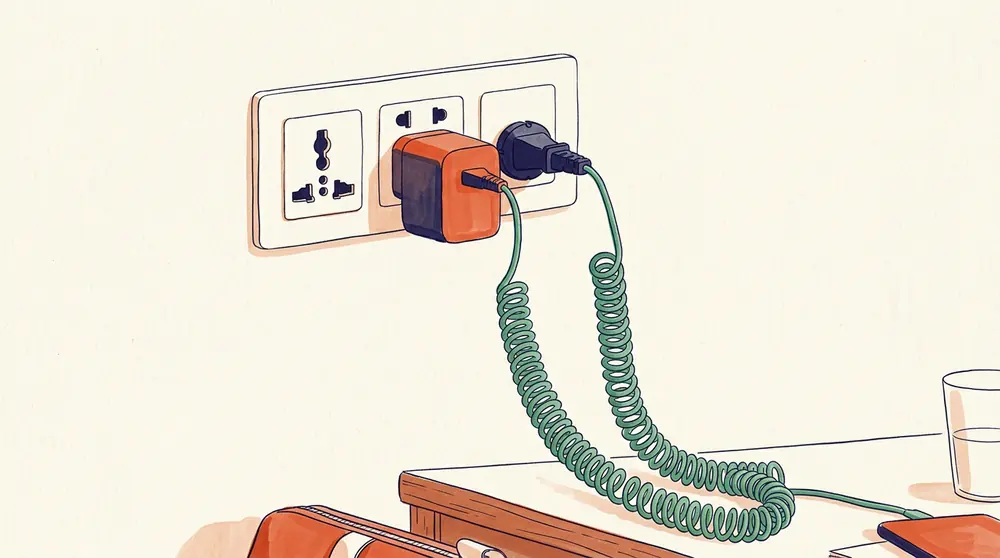
The wall-socket reality: Many Chinese outlets are combination sockets engineered to accept more than one pin shape on the same faceplate. Newer hotels and newer buildings are more likely to have these multi-shape plates installed. Still, combination faceplates do not mean every plug slides in smoothly. Travel-adaptor.com notes that US ungrounded (type A) plugs fit some, but not all, Chinese outlets, and recommends carrying a type I adapter for the widest fit across the country. Relying on bare pins is a gamble, particularly in older buildings where sockets may only accept a single format.
Do You Need an Adapter?
Start by matching your home plug against the table below. Treat this as a guide to pin geometry rather than a guarantee about the exact faceplate waiting at your hotel desk.
| Your country | Your plug | Likely result in China |
|---|---|---|
| USA, Canada | A (two flat pins) | Fits many sockets. Grounded B plugs with a third pin may not fit |
| Japan | A | Fits many sockets. Check the voltage (Japan is 100V) |
| Germany, France, Spain, Italy | C, or F/E with a larger body | Slim two-pin C plugs fit many sockets. Larger grounded plugs may need an adapter |
| Australia, New Zealand | I | Fits type I sockets |
| UK, Ireland | G | Needs an adapter |
| Singapore, Hong Kong | G | Needs an adapter |
| India | D or M | Needs an adapter |
| South Africa | M or N | Needs an adapter |
Look closely at the third grounding pin on North American type B plugs and the bulky round collar on European type E or F plugs. Phone chargers from North America and Europe usually use slim two-pin plugs (types A and C) that slip into combination sockets, whereas larger grounded plugs may need an adapter. If your itinerary combines mainland cities with Hong Kong or Macau, plan for two different standards: Hong Kong and Macau use their own sockets (type G in Hong Kong), so a plug that works there will not necessarily work on the mainland, and vice versa.
Choosing what to buy
Your best purchase depends on how many countries you visit and how many cords you carry:
- Easiest option: A universal travel adapter covering type A, C, I and G slots handles both mainland China and a Hong Kong stopover in one unit. Estimated retail price is ¥50-100 (US$7-15).
- Cheaper option: A simple single-purpose adapter matched to your home plug shape costs an estimated ¥10-30 (US$1.50-4.50). It is the simpler choice if you only travel between home and mainland China.
- Phone-only setup: If you only charge phones, bring a standard USB charger and cable. Any charger labeled 100-240V handles the current safely, though you may still need a simple plug adapter so its pins fit the wall.
Voltage in China: The 220V Check
China uses 220V, 50Hz.
| Region | Nominal voltage |
|---|---|
| China | 220V |
| USA, Canada | 120V |
| Europe | 230V |
| UK | 230V |
| Australia | 230V |
| Japan | 100V |
Travelers arriving from Europe, the UK or Australia already use appliances built for 230V, so Chinese current poses no voltage shock. Travelers from the USA, Canada and Japan face a sharp jump from 100V or 120V up to 220V. Japanese plugs are deceptive here: a Japanese type A plug shares the two flat parallel pins of many Chinese sockets, making it easy to plug a 100V-only appliance straight into a 220V wall by mistake.
Reading your device labels
Inspect the fine print molded into your charger brick or stamped near the power cord before leaving home. If the label reads "INPUT: 100-240V" (or 100-240V~, 50/60Hz), the internal power supply automatically adjusts to 220V and needs only a plug adapter if the pins do not match.
Usually dual voltage:
- Phone, tablet and laptop chargers
- Camera battery chargers
- Most power banks and earbuds charging cases
Check before you plug in:
- Hair dryers, curling irons and straighteners
- Electric shavers and toothbrush chargers
- Small appliances such as kettles
Warning: Plugging a 120V-only device into a 220V outlet can ruin the electronics and can create a fire risk. A passive plug adapter only reshapes the metal pins; it does not change the voltage. If a device label states 110-120V only, either leave it at home or pair it with a proper step-down converter rated for the wattage of that device.
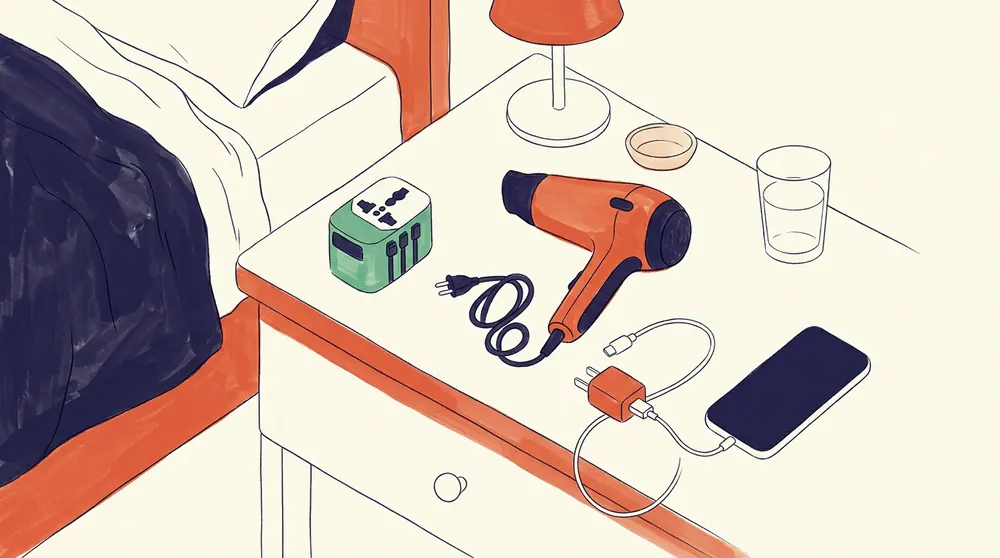
Solving the hair dryer problem
High-wattage heating tools like hair dryers, straighteners and curling irons are the appliances most frequently ruined by foreign voltage. Even when paired with a converter, heavy heating elements strain travel transformers. Choose from three practical workarounds in order of convenience:
- Use the hotel's hair dryer. Most mid-range and better hotels provide one in the bathroom or desk drawer, and you can ask reception if your room has none.
- Buy a cheap local dryer in China. Picking one up locally costs roughly ¥30-50 and guarantees native 220V compatibility with a Chinese plug already attached.
- Bring a dual-voltage dryer (110-220V). Check that the voltage selector switch is set for 220V before plugging it in.
For laptops and their grounded power bricks, read our laptop voltage guide.
What to Expect in Hotels
Which sockets you encounter depends heavily on the building's age and hotel class. The patterns below reflect general traveler observations rather than official data, so always inspect the room before settling in for the night:
- Higher-end hotels: Rooms often have combination sockets positioned at both the desk and the bedside, and may include built-in USB ports. If your plug still does not fit, ask reception to lend you an adapter before going out to buy one.
- Mid-range hotels: Outlets near the work desk are usually fine, but check near the bed. Check beside the bed before you plan to charge your phone overnight as an alarm.
- Budget hotels and hostels: Socket types and physical grip vary widely. Older buildings may only offer one socket shape.
- Apartments and homestays: Setups vary by owner (Airbnb removed its mainland China listings in 2022, so book through other platforms). Message the host before booking if you rely on running a specific medical or work device.
Our hotel check-in guide covers useful requests to make at the front desk when you arrive.
Buying Adapters and Power Strips in China
- Convenience stores (便利店): Carry a basic selection for emergencies, though small branches are not always stocked.
- Electronics stores: Xiaomi stores (小米之家) and neighborhood phone shops stock reliable USB chargers and cables.
- Supermarkets: Walmart (沃尔玛) and similar large chains sell both simple plug adapters and multi-outlet power strips.
- Online delivery: Taobao and JD.com deliver to hotels, usually within 1-2 days in cities. See our Taobao guide to set up an order.
To locate a shop quickly on the street, open Amap (高德地图) and search 小米之家, 便利店 or 电器. If you are traveling with a laptop, camera and phones, buying a local Chinese power strip at a supermarket is often smarter than buying multiple plug adapters: the strip lets you charge several devices from one wall socket.
Charging on Trains, at Airports and on Flights
- High-speed trains: Many seats have a power socket, but trains do not always provide one outlet per seat. Carry a charged power bank so you are not competing with row-mates for a single plug. Our train ticket guide explains seat classes and onboard layouts.
- Airports: Most terminals provide public charging points, though working sockets near gate seating fill up fast. Do not rely on finding an open seat with power right at your departure gate.
- Flights and city transit: Airport security enforces strict capacity and labeling rules on lithium batteries. Read China power bank rules for flights and trains before putting a battery in your carry-on bag. If your phone dies while sightseeing, you can use shared charging stations across cities; see our guide to renting a power bank.
Common Device Scenarios
Will my iPhone charger work?
Yes, for voltage: the charger is dual voltage (100-240V), meaning only the physical plug shape matters. A US two-pin plug fits many Chinese sockets directly, while travelers with other plug shapes just need a simple adapter.
Will my laptop charger work?
Almost certainly, provided the power brick label states 100-240V. Check the label on the brick first, and remember that three-pin grounded laptop plugs often need an adapter even when two-pin phone chargers from the same country fit.
Can I charge multiple devices from one hotel socket?
Yes, either by bringing a multi-USB wall charger from home or by buying a cheap local power strip once you arrive in China.
Packing Checklist
Essential
- Phone charger and cables
- Power bank, carry-on only
- Plug adapter if you are from a type G, D, M or N country
Optional
- Universal adapter with USB
- Multi-USB charger
- Travel power strip
Leave at home
- 120V-only hair dryer or curling iron
- Heavy transformers
See the full packing list for other essentials before departure.
FAQ
What plug type does China use?
Travel references list types A, C and I for China at 220V and 50Hz. Many sockets accept more than one plug shape, though not every socket does.
Do I need an adapter for China from the US?
Often a US ungrounded two-pin plug fits, but not every Chinese socket accepts it, and three-pin grounded plugs may not fit. Bringing a universal adapter that includes type I removes the guesswork, and any US 120V-only device will also require a voltage converter.
Do I need an adapter for China from the UK?
Yes, because UK type G plugs do not fit mainland Chinese sockets. Bring either a dedicated type G to China adapter or a universal travel adapter.
Is China 110V or 220V?
China runs on 220V at 50Hz.
Can I use a US hair dryer in China?
You can use it only if the label shows 100-240V or dual voltage. A 120V-only dryer will be damaged on 220V power unless paired with a proper step-down converter.
The China Survival Kit includes a packing checklist and hotel survival guide with everything you need to know before checking in.
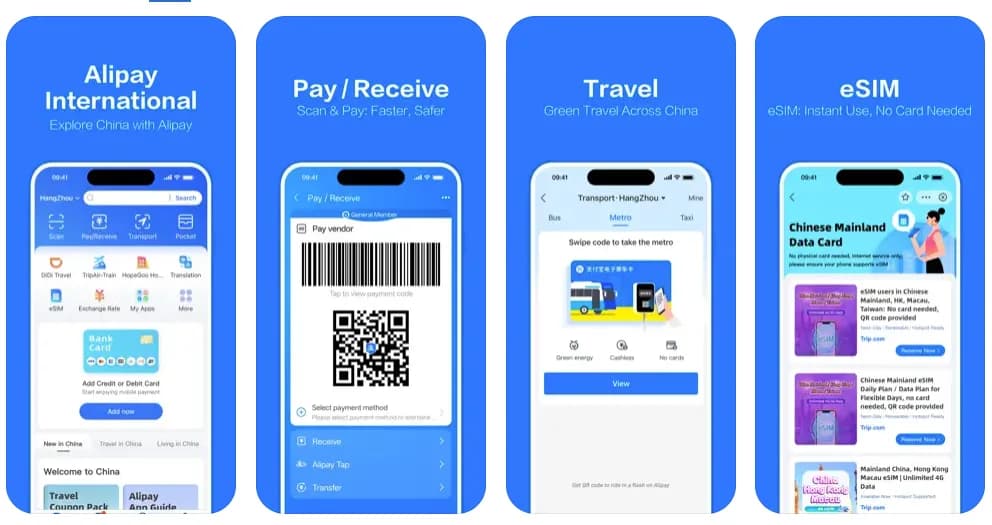
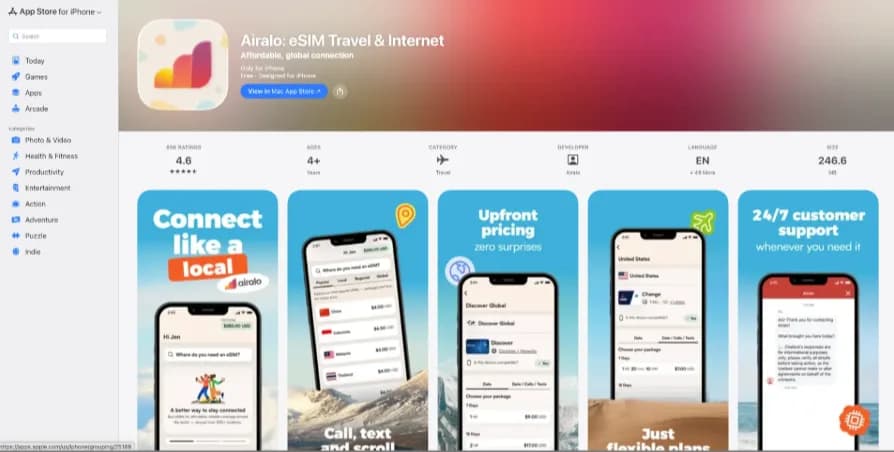
Essential Apps for This Guide
All 19 apps →
More guides like this
- Shopping & Daily LifeCan I Use My Laptop in China? Power and Voltage Guide
- Shopping & Daily LifeChina Power Bank Rules on Flights and Trains (3C, 100Wh)
- Shopping & Daily LifeRent a Power Bank in China: Meituan, Jiedian, Prices
- Shopping & Daily LifeLaundry in China: Hotels, Laundromats, Same-Day (2026)
- Shopping & Daily LifeShipping Your Stuff Home: Mailing Parcels from China
- Shopping & Daily LifeTaobao in English: How Foreigners Use It in 2026
Rules and apps in China change often. Guides are checked against official sources — see our editorial & verification standards. Spotted something out of date? Tell us at [email protected]. Published December 10, 2025.